
The Simulation Hypothesis, Reprise 4
Non-algorithmic Reasoning

On October 21, 2025 a paper called “Consequences of Undecidability in Physics on the Theory of Everything” by Mir Faizal, Lawrence M. Krauss, Arhid Shabir, and Franscesco Marino was published in the Journal of Holography Applications in Physics issue 5. It was subsequently released at Arxiv on a date I cannot trace back (according to the webpage, it was submitted on July 29, 2025). I found out about it indirectly, via a reddit thread of November 7, 2025.
It’s main topic is that a so-called ‘Theory of Everything’ cannot be formulated by a single axiomatic structure (and algorithmic calculations acting on these axioms), as certain facets of reality will remain computationally undecidable and can be accessed only through non-algorithmic understanding.
To quote from the abstract:
“We formalize this by constructing a “Meta-Theory of Everything” grounded in non-algorithmic understanding, showing how it can account for undecideable phenomena and demonstrating the breakdown of computational descriptions of nature does not entail a breakdown of science.”
Therefore, according to this paper, reality is Gödel incomplete1—probably a better formulation is: reality is an amalgam of systems that each individually can be Gödel complete, while the overarching system of reality itself—by definition—must be Gödel incomplete. Then, these separate systems can be understood (and proven) through non-algorithmic reasoning. As a consequence—mentioned almost as an afterthought—it disproves the simulation hypothesis:
“Because any putative simulation of the universe would itself be algorithmic, this framework also implies that the universe cannot be a simulation.”
In other words, because the universe is Gödel incomplete, it cannot be generated by a simulation, as such a simulation, through the usage of algorithmic computation, would be Gödel complete by definition.

Therefore my reasoning of: “reality breaks down at the double-slit experiment, meaning it must be Gödel complete and thus self-sustaining (meaning the simulation hypothesis is wrong)” is faulty, because reality is more complex than that2. So complex, in fact, that it cannot be simulated by a Turing machine (or its equivalent).
Therefore, this paper implies that there must be a non-algorithmic reason that explains the double-slit experiment (and the other phenomena, such as the black hole information paradox, renormalisation, and many other so-called ‘undecideable domains3’). Or—as almost all scientists hope—that every phenomenon in reality is ultimately understandable.
Returning to the double-slit experiment, are all those, often farfetched, hypotheses part of ‘non-algorithmic reasoning’? Well, I like to think that non-algorithmic reasoning should heed Ockham’s razor. Conjuring a whole new Universe every time a particle has to choose between two states as the many-worlds hypothesis seems to require? Crazy. Declaring the observer the be-all and end-all (even conjuring up the Big Bang by remote), as the complementarity principle seems to require? Just as bonkers. Requiring a message wave/particle for every photon or electron? Then they surely cannot be true ‘elementary particles’, right? And invoking time travel? One could go back in time and tell Gödel not to bother with that incompleteness stuff.
Interestingly, there’s an Israeli scientist called Ramzi Suleiman who has an explanation using special relativity in his paper: “A relativistic model of matter-wave duality explains the results of the double-slit experiment”. What? Isn’t it supposed to be the other way around; that is, quantum mechanics should explain the singularities (black holes) in general relativity4?
Anyway, Suleiman proposes that the wave/particle duality depends on the speed of the elementary particle (see diagram): at velocity 0, the wave/particle is 100% particle, at the speed of light it is 100% wave packet, and at 1/3 of light speed it is exactly 50/50 wave/particle.
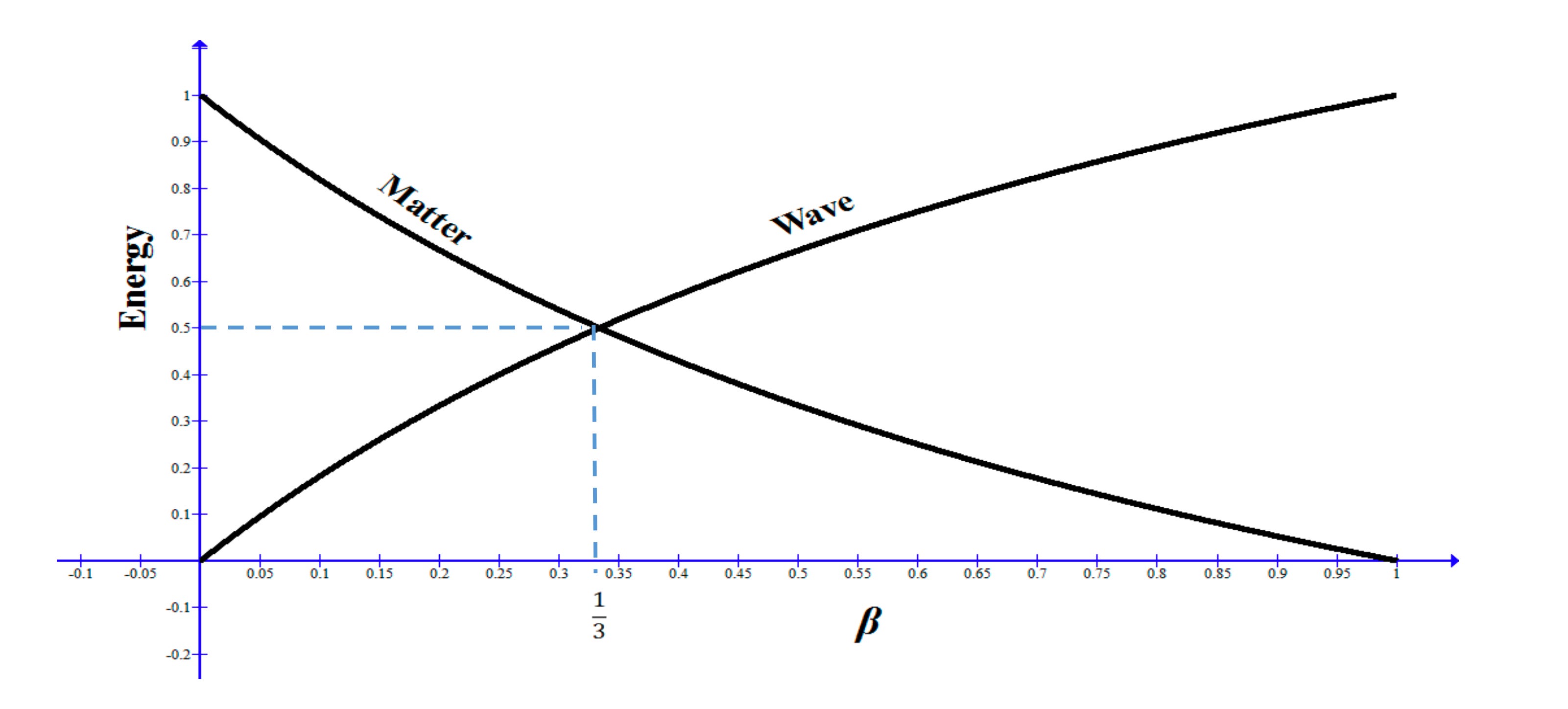
Now, as the electron is fired from the electron gun, it has a very high speed, meaning it’s almost all wave, and that wave packet (as per Schrödinger’s equation) wil be ‘smeared out’ and pass through both slits at once. The resultant ‘pilot waves’ will interfere with each other (eventually producing the interference pattern). Then, as the (re-united?) wave packet hits the screen, its velocity decelerates quickly, meaning it ‘collapses’ into a particle. It also explains that putting a measurement device in the electron’s path reduces its speed so much it becomes mostly particle-like, meaning the wave part is too small to pass through both slits at once, and the interference pattern disappears.
Even more interestingly, he predicts how the fringe width of the interference pattern depends on the speed of the elementary particle, something that can be tested5.
To the best of my understanding6, this is applying the axioms of one field—special relativity—to another field—quantum mechanics. Is that ‘non-algorithmic reasoning’? On the one hand, no, as Suleiman uses mathematical formulæ and calculations to derive his results. On the other hand, yes, as he uses axioms from a different system—special relativity—that does not fit in the consistency of the other system—quantum mechanics. Advantage: he gives a testable prediction.
Which is what I wonder about non-algorithmic reasoning: will it be able to deliver testable results?
On the other hand, Einstein’s special relativity seems like the poster child of non-algorithmic reasoning—by way of lateral, out-of-the-box thinking—by considering that the speed of light (in a vacuum) is absolute, while time and even length of a body are not. Same with general relativity, namely that gravity is not a force, but rather a deformation of space-time. Eventually, both theories found their mathematics7. In that manner, Suleiman’s hypothesis might be non-algorithmic (lateral, out-of-the-box) thinking. If he is correct, of course.
Frustratingly, I came very close to discovering non-algorithmic reasoning in my Forever Curious/Forever Thrilled duology. In those, Na-Yeli Maya and the Moiety Alien communicate with aliens from another Universe—through the naked singularity at the heart of the Enigmatic Object—and perform, what I call, the Intra-Universal Handshake. With that the aliens from the other Universe prove the axioms of our reality that we cannot prove (note that in these novels I also assumed that reality—both ours and that of the aliens in the other Universe—is Gödel complete), and we prove the axioms in the other Universe for the aliens in the other Universe8. Close but no cigar9.
Concluding: if messrs. Faizal, Krauss, Shabir, and Marino are correct, then the simulation hypothesis is false. I’m not a physicist, nevertheless I strongly suspect they are10.

Postscript: if reality is not a simulation, then the question remains what created it. Is it a self-sustaining system that arose from the Big Bang (or rebounced from the Big Bounce)? Did it split off from a higher level of existence (the multiverse or even an ‘Ultimate Reality’)? Or did god create it? I don’t know, and I don’t expect this to be resolved in my lifetime. My current thinking, thought, is agnostic atheistic11.
Support this writer:
Like this post!
Re-stack it using the ♻️ button below!
Share this post on Substack and other social media sites:
Join my mailing list:
Author’s note: and there it is, the big reveal. Are you happy that you live in an actual reality, or would you have preferred a simulation? Or do you not care at all?
Anyway, now that the simulation hypothesis has been falsified, we can concentrate on physical reality and how we experience it. Hint: my trilogy is called the ‘Consensual Reality’ trilogy for a reason. . .
I hope this was of interest to you, and many thanks for reading!
They even refine it by including Tarski’s undefinability theorem and Chaitin’s information-theoretic incompletness;
And—as mentioned in the previous part—if reality is Gödel complete, it can theoretically be simulated;
Several of which—see page 14 of the paper—I have no understanding;
Which seems to be the general take in the physics community. Yet the ‘Consequences’ paper says not, but a non-algorithmic type of reasoning;
But, to the best of my knowledge, hasn’t been;
I know, I’m still grappling with it. But if I keep thinking forever, nothing will be written. At some point I’ve got to write my thoughts down—for better or worse—as it helps me get a better understanding;
And have stood the test of time, so far;
I even had the aliens in the other Universe indirectly seed our universe with a mechanism—the superposed aliens or algorithms—that would accelerate (or even seed) intelligence in our Universe. If you go, you might as well go all the way;
Is this why I don’t smoke?
right, that is. I know they are physicists…;-)
An actual proof of either god’s existence or god’s non-existence would be required, yet I suspect that in case somebody finds evidence of the non-existence of god, some theists would argue that some faraway god created the proof of god’s non-existence. In other words—to paraphrase the late, great Terry Pratchett, who most probably got it from Hindu mythology—it’s turtles all the way down;
Very interesting, and I think I followed most of it!