
A Puppet Show
Sample chapter of "Divine Denoumements & Celestial Sihouettes"

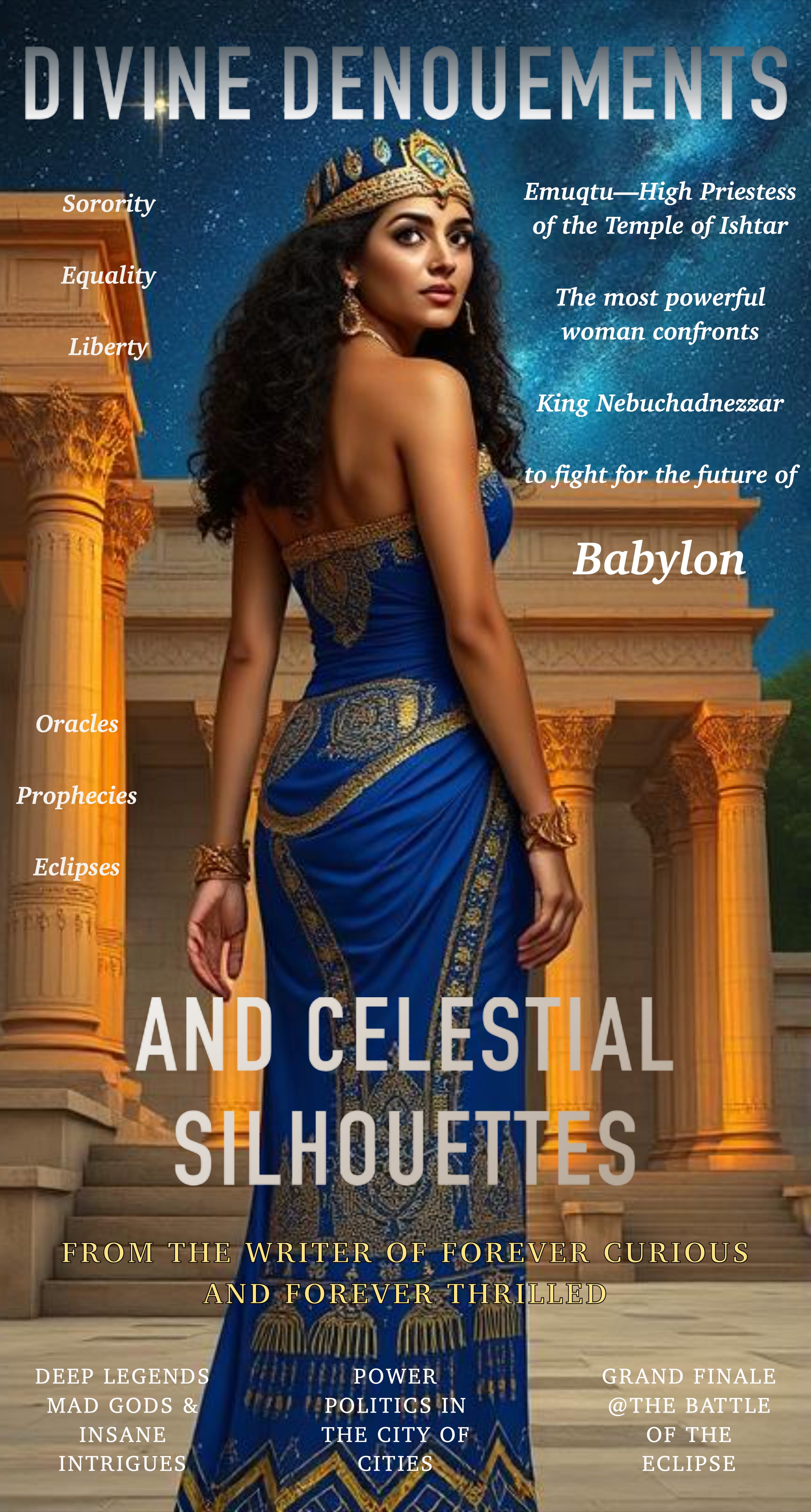
—A Puppet Show—
April 6, 586 BC
While Aquarius hosts a Grand Trine, Libra features a sextile between Venus and Mars. This is the time to reach out and embrace a new opportunity, such as co—operating with an associate or a confidante. Two know more than one.
—your daily horoscope—Libra;
Babylon, the twenty-first day in the month of Bara.za.gar during the nineteenth year of King Nebuchadrezzar’s reign. Third day of Akitu.
As per tradition, today the statues of the gods—which are now imbued by the gods themselves—are taken out of the cellæ of the temples at the crack of dawn. The four strongest priests of the Temple of Ésagila are panting from the effort after they’ve dragged the huge statue of Marduk onto the plaza—after all, he is the god of gods, which must be reflected in the size of his statue. Other priests have a somewhat easier job as the smaller statues of their gods are put out in the open, then dust them off and polish them up as statues of Nabû, Ninurta, Nergal, Tammuz, Enki, Shamash, Sīn, Gula, Enlil, and others appear on the streets and public squares. The godly statues have a cleansing effect, as the evil spirits that normally float around do not dare to be near them.
Just as crucial as getting the godly statues out is getting them dressed. Each temple has its own set of garments made from sapitu or larsu—the textiles specially prepared by the weavers, and only the hullālānītu priestess class is allowed to put the garments on the godly icons. First they dust them off, quite thoroughly, then they sprinkle them with sacred sammu-oil—the same oil used to unlock the cella that held the statue—then some hold up mirrors to the divine statue while others put on the sacred garments: the sapitu undergarments first, then the beautifully embroidered larsu skirts, shawls, and—in some cases—the holy headdress.
Next, the make-up hullālānītu priestesses apply various colourings on the faces of the godly icons. The final touch is the application of the special jewellery by a temple-approved kutimmu. Now the divine statues are ready to be shown to the public.
After presenting the brand new Ishtar statue, Emuqtu leads her following and a large group of worshippers along the Hanging Gardens to the nearby Temple of Ninmah, next to the brand new Ishtar Gate. Shibtu, the High Priestess of the Temple of Ninmah, is one of her best friends. She also houses the guild of seamstresses, who are expert puppet makers. They have set up market stalls in front of their temple, where volunteers are taught the basics of sewing and puppetry making.
A lot of those volunteers are children. Kids love to make puppets or be creative in any other way. Of course, not everybody is good or eager to make puppets, so there are also a few stalls where people can draw on papyrus or sculpt wooden statuettes.
As they approach the Temple of Ninmah—which is only a short walk—they can see a shining new statue of Ninmah. Everybody—with one single exception—is surprised.
Just as with the new Ishtar statue, the novel Ninmah sculpture displays a few likenesses with its High Priestess. Ninmah—who is, after all, a nurturing fertility goddess—has quite prominent breasts like Shibtu, the same welcoming smile and the same very long, very thick jet black hair all the way to her well-rounded bottom. Her crown depicts figurines of the other main gods while she stands on a mountain. Her larsu leaves one breast uncovered—ready for feeding—while she carries two lion cubs.
“Nice to see you, and what a coincidence,” Emuqtu says with a wink. “The gods must have conspired.”
“Good to see you, too,” Shibtu says as she embraces and hugs her fellow high priestess and confidante, “and all the people you bring. Let’s get going.”
The people in Emuqtu’s wake mingle with those already at the various market stalls. The seamstresses and their assistants hand out cloth and sewing needles and string, the sculptors and their helpers distribute pieces of wood, hammers and chisels, and the scribes and their apprentices give out papyrus and quill pens.
On the third day of Akitu, apart from the statues of the gods to be taken out of their temples—there is no mention of how old these statues must be—puppets representing evil gods and demons are made, to be burned in effigy on the sixth day. Those who are not adept at making puppets can contribute by creating devilish statuettes or drawings of terrifying ghosts, all of which will also be burnt on the sixth day.
Not only children use their skills to produce evil puppets, horrifying drawings or angry statuettes, but also quite a lot of adults take part. While it’s mostly girls who sew and stitch together the demon dolls—alone or in groups collaborating on making the Seven Red Serpents—it’s mainly boys who sculpt angry icons and satanic statuettes. An almost equal mix of girls and boys draw scary devils and evil gods, helping each other and providing mutual inspiration.
Some are so good at drawing that Shibtu almost feels bad about having to burn their beautiful papyrus portraits later. Similarly, some of the puppets and sculptures are also extraordinary, and Shibtu makes sure to know who these talented children are, so that she can offer them an apprenticeship in her temple when they reach the right age. Preferably before Emuqtu lures them into her orbit—in particular, those with scribing or engineering talents.
Roughly speaking, Emuqtu attempts to recruit the ones with practical skills, ideally preparing them for an entrepreneurial vocation, while Shibtu tries to enlist the more artistic ones—the painters, the sculptors, the bards, the musicians, the dancers and the scribes of the fantastic epics. After all, what’s the point of generating wealth when you can’t enjoy it?
Neither are the desires of the two high priestesses completely different, as there is plenty of overlap. Emuqtu uses many of Shibtu’s dancers and performers for the theatrical play of “Ishtar’s Descent into the Underworld”, the big event of tomorrow.
But today, after all the puppets, portraits, and statuettes have been made, Shibtu’s troupe will perform “How Ninmah and Enki Created Humans”. It’s not as grand and splendorous as “Ishtar’s Descent into the Underworld”, but a lot more intimate and lived-in, more in line with Shibtu’s aura of motherly affection. Emuqtu’s charisma and intensity—like Ishtar’s insatiable curiosity and tempestuous willpower—are one of a kind, and Shibtu prefers to do her own thing.
🧚🏽♀️🧚🏽♂️
In the afternoon, when all puppets, portraits and carvings are ready, a small stage is set up for the play of the day—one of the many creation myths enacted during Akitu. Obviously, Shibtu plays Ninmah, while her husband Adapa plays Enki—who some would call a trickster god, and others a fixer god—the deviously smart one whom the other gods call upon when they’re in a quandary. The two know each other inside out, and many of the double entendres they make during the play go right over the heads of the attending children while their parents howl with laughter. Adapa often improvises, either causing Shibtu to forget her lines or to collapse into a laughing fit.
The children all take it in stride, because that’s who Enki is: witty, devilishly clever and ad-libbing his way out of every dilemma.
The first person on the stage, however, is neither Shibtu nor Adapa, but Emuqtu dressed up as an elderly woman with lines of charcoal on her face that make her look much older than she is. She needs a stick to keep walking, easy-as-she-goes and—while trying to mask her tremors—she sits down on a comfy chair adorned with celestial symbols.
“Before humanity,” the great mother Namma croaks (Emuqtu could adapt her voice to almost any occasion), “there was only the toil of the lesser gods. The Annunnaki ruled from above while the Igigi laboured below. The Igigi shaped the rivers and carved the land. They filled the valleys with fertile soil and enhanced the lower slopes of the sierras with lush forests. They created oases in the desert and grottos in the mountains. Yet they were only with a few, and their work was never finished. They worked and they worked, until they could bear it no more. And because their work lessened, chaos ensued on the Earth: storms, floods, draughts and earthquakes wreaked havoc on the land.”
“I could take it no more,” the great mother Namma says as her voice lowers to a fragile whisper. “And what can a poor old woman do? So I awoke Enki, the great fixer, the trickster amongst gods and Ninmah, the goddess of empathy. They had to do something, as utter chaos enveloped the Earth.”
Cue to Shibtu—as the goddess Ninmah—entering from stage left, and Adapa—as the god Enki—entering from stage right, while the chair with great mother Namma is pulled backwards until it disappears through an opening in the painted curtains.
“The Earth is in horrible disorder,” Ninmah says in despair. “We must do something. Enki, you must devise a cunning plan.”
“Chaos is evil,” Enki says. “I will use its wicked forces against it.”
So Enki and Ninmah disappear stage left to gather divine clay from the Apsu and the sacred essence of Gestu, the god of intelligence. From stage right, a huge table with plenty of wet clay is pushed on the stage. Hidden in a large cabinet at the back of the table is Shibtu’s oldest daughter, Atalya, who will hand the correct clay puppets to her mother and father during the play. She loves it, knows the play by heart, and even gently tries to correct her father as he goes off in one of his improvisations.
Returning from stage left, Ninmah and Enki stand behind the large table as their divine hands shape the clay and create the very first humans. But they don’t get it right on their first, second or even third try. This first human-like contraption Ninmah produces has four legs, one arm and two heads. “That’s not right,” Enki says and throws the faulty clay figurine into the audience. Fathers and mothers jump up in an effort to catch it, as it is the perfect memento of the play, often given as a present to their children.
Then Enki makes a human-like figurine with two legs and six arms and a feathered bird’s head. “That’s also not right,” Ninmah says and throws it into the crowd, taking care that it’s heading for a different part of the plaza. They make four more mistakes—six is the basic number in Babylonian algebra and beyond—before they finally produce a figurine with two legs and two arms (which are equally long, this time) and one head. The figurine has two breasts and one vagina, so it is obviously a woman.
“That’s more like it,” Ninmah says as she places it on the table. “She’s pretty, right?” The latter aimed more at the audience than her partner-in-crime, Enki.
“Not bad,” Enki says. “Wait until you see mine.”
Enki then creates a figurine with two legs, two arms and one head, but without prominent breasts and a penis. Yet his penis is very big, almost like a third leg. “Here’s a man,” Enki says while looking smug. Most of the men in the audience cheer.
“That’s too much,” Ninmah says. “All the blood from his head will go into his penis.”
“He will be mighty,” Enki says, raising his hands and balling his fists.
“He will be stupid,” Ninmah says and rubs clay off the figurine’s penis until it is more normal-sized. “Women like their man smart.”
Now, most of the women in the audience cheer as quite a few men moan while the giant penis is cut down to size. The children giggle because their parents laugh, as most of the innuendo goes right over their little heads. Yet they watch in awe as Ninmah and Enki continue to produce normal humans, setting them up on the table.
Enki and Ninmah feel good as the humans they create are normal and start doing their work. Nevertheless, as they make even more humans, mistakes start to creep in, again. The first one happens as Ninmah takes clay from the Apsu, but this time she fashioned a man who could not bend his outstretched weak hands. This means he cannot work to earn his daily bread. Enki looks at the imperfect man and decrees his fate: “You are unable to steal, so I appoint you servant of the king.”
The second mistake is Ninmah making a blind man. Since he cannot see, he cannot work to earn his daily bread. “You are the perfect man,” Enki says with a wink, “to marry a woman not bestowed by the gift of beauty.” Some men in the crowd giggle as Ninmah gives Enki a stare that would be deadly to mortals. “Those lacking outer beauty,” Ninmah says, “often have a surplus of inner beauty. Anyway, the poor man is still blind. How will he make a living?” Enki thinks for a while: “I bestow you with the gift of music,” he declares. “You will become a minstrel at the court of the king.”
Ninmah’s third mistake is a man with both feet broken, paralysing them. He cannot walk, so cannot earn his daily bread. Ninmah provides him with crutches, so he can walk without assistance. “Your feet are broken,” Enki declares, “so do not marry, as you cannot run away during a fight.” This earns Enki a stump from Ninmah while the audience bursts with mirth. “That’s not fixing him,” Ninmah reminds Enki. “That’s limiting him.” “Well, since your arms are fine,” Enki declares, “you will be a kutimmu in the queen’s court.”
At her fourth effort, Ninmah produces a man who cannot hold back his urine. This makes her very uneasy, while Enki remarks, “Is he only two months old?” to general laughter. “No, he’s a full-grown man and still fails his potty training,” Ninmah looks sad. Eventually, Enki bathes the man in enchanted water and drives out the Namtaru demon from his body. Now he is cured and can become a productive member of society.
Her fifth fault is a woman who cannot give birth. Since Ninmah is the goddess of motherly love, this makes her despair. “The poor woman,” Ninmah fights to hold back tears. “She will never have a cute little boy or a smart little girl.” Enki looks at the barren woman and decrees: “You will become a weaver in the queen’s household.”
With her sixth flawed effort, Ninmah fashions one with neither penis nor vagina on its body. Enki looks at the one with neither penis nor vagina and says: “You are Nibru, and you will stand before the king.” This is why many of the king’s bodyguards are eunuchs.
Now it’s Enki’s turn to create, again, and he devises a shape and calls it Umul. Umul’s head is afflicted, its pace of walking is afflicted, and its neck is afflicted. Its ribs are afflicted, its lungs are afflicted as it can hardly breathe, its heart is afflicted, and its bowels are afflicted.
With its hand and its lolling head, it cannot put bread into its mouth; its spine and head are dislocated. The weak hips and the shaky feet cannot carry it on the field. Enki really created an imperfect human being.
Then Enki says to Ninmah: “For your imperfect creatures I have decreed a fate. I have given them their daily bread. Now you should decree a fate for my creature, give him his daily bread, too.”
Ninmah is appalled at the fate of this remnant of a human being, this poor monstrosity created by Enki. The miscreation is so weak that Ninmah cannot think of a way for it to earn its daily bread. Yet Ninmah loves everybody, no matter how weak, no matter how deformed, no matter how disabled. She thinks deeply and says:
“You poor creature, you cannot dwell in heaven. You cannot dwell on earth. You cannot come out to look at the land. You are like a refugee: your city is ruined, your house is destroyed, and your child has been taken captive. You are a fugitive who has to leave the E-kur.”
“But I still love you, I still care for you. You will be part of my household, where I will provide your daily bread. Your voice, no matter how weak, will be heard. I will soften your pain, I will listen to your laments, as I care for everyone, no matter how strong or weak.”
Saintly Ninmah becomes so overwhelmed that she starts to sing:
I feel your hopes, I see your dreams and in the night, I hear your screams
Don’t turn away, but take my hand, and as you make your final stand
I’ll be right there, I’ll never leave, and all I ask of you is: believe
Now Ninmah gets up and squarely faces the audience: “Those who do not love the weak cannot truly love the healthy and strong. Those who turn their head from those who suffer do not deserve mercy when they are in need. Real humans care for everyone, especially the unlucky ones.”
“Devious Enki,” Ninmah’s tears stream down her face in despair. “How could you create a human so imperfect that even I cannot fix him? Why?”
“Because I can,” Enki says, “and because it will happen more times in the future. We are gods, but even the gods are not perfect.”
“This is cruel,” Ninmah says. “This poor human does not deserve this.”
“Fate can be cruel,” Enki says. “Yet we must deal with it.”
“Then, if I cannot fix him, I will still love him,” Ninmah says. “I will feed him, I will help him in any way I can. I will treat him like a human being.”
“Your empathy is your power,” Enki says. “It is stronger than my cunning. Yet there will be more like him. Who will take care of them?”
“I will make the land fertile so there is plenty of food,” Ninmah says as she heaves her magnificent breasts in despair. “I will make humans fertile, so fertile that there will be plenty of healthy humans. They will take care of the unlucky ones amongst them.”
“I can see why you are the goddess of the mountains,” Enki eyes her cleavage as the adult part of the crowd bursts out in laughter. “You will climb all of them and scale them, no matter how steep. Empathy flows from your chest like water from the mountaintops.”
“And so it was ordained, and so it is today,” Ninmah says. “Humans will be created, yesterday, today and tomorrow. Not all of them will be perfect, and it is our job—” she makes a broad gesture encompassing the whole crowd on the plaza before the temple of Ninmah, “—to take care of the unlucky ones and give them our love.”
“And so the gods created humans,” Shibtu says. “And the humans are all different, and not perfect.”
“Why are we not all the same?” A couple of children cry out, incredulously. “Now it’s not fair.”
“Nobody is perfect,” Ninmah says. “Not even the gods. Yet there is one power that we all have. A power that burns within us all, a powerful feeling that can take us through the hardest of times, a power that can move mountains. It is the power of love. I love you all.”
She puts her hands to her pursed lips and then throws air-kisses to everybody.
“Love you, too, Shibtu,” the children—and quite a few adults—cheer. “You are our great mother.”
Shibtu gestures for the other players and the stagehands—including her own daughter Atalya, who was hiding in the table’s cabinet—to enter the stage. They grab hands and then bow to the audience as applause and cheers erupt.
Support this writer:
Like this post!
Re-stack it using the ♻️ button below!
Share this post on Substack and other social media sites:
Join my mailing list:
Author’s note: competition is intense. And while my chances of winning are—like those of all but one of those other entries—low, I do hope that as many readers as possible check out my entry, and then give their honest opinion.
Furthermore, I can’t wait untl the end (reader engagement closes on March 20, 2026 midnight GMT) because by then it’s way too late. I entered my sample chapter and the rest on February 1, but it took until February 19 until they finally appeared. In the meantime, those who had entered the earliest had already gathered more than 50 reads and recommendations, which is probably an insurmountable lead1.
Many thanks for reading, and if you wish, spread the word!
Prove me wrong, I dare you . . . 😇