
David Bowie Eyes—Part 1
In which reality becomes skewed


—prologue—
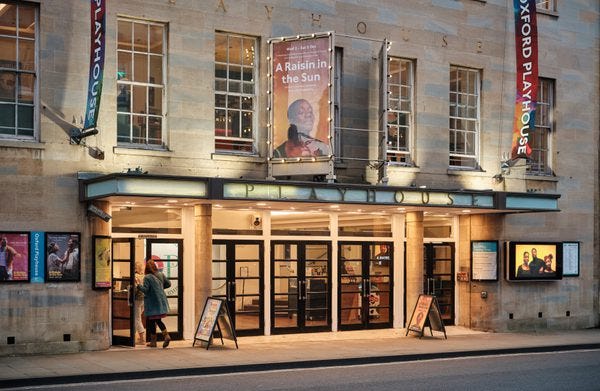
A study in a city of studies, Gaye Modisa was mentored by David Deutsch in her Oxford PhD thesis about Constructor Theory. A nerd in a town of nerds, she could be a poster child for the black nerds community with her wild afro, her always topical T-shirts—nerd is the new black, talk nerdy to me, black nerds matter—and bottomless knowledge of even the most trivial Sci-Fi (be it TV-shows, movies, games, comics, books, everything, as her curiosity was well-nigh insatiable). An arty-farty in a locale of arty-farties, she volunteered in a small, experimental amateur theatre hidden in a dank, cobbled alleyway only known to locals and the odd lost tourist who chanced upon it, like a solitary oracle in a world shrouded by clouds of disinformation.
Yet, while small and mainly visited by the in-crowd, it had an unknown and very generous sponsor, allowing the small theatre—Ye Olde Water Tower—to invest heavily in ultra-modern equipment. This was where Gaye came in. She set up the advanced Augmented Reality equipment—projecting sound, vision, vibration and even smell—and controlled the projections, while also prompting the actors, if needed, through their as-good-as-invisible EarPods. A high-tech magical stagehand, sound engineer and advanced prompter all in one. Which was great, as she couldn’t act to save her life.
Melissa Lilith—who went by the stage name Medusa—was Ye Olde Water Tower’s principal director and one of its main actors. Her suicidal blonde look emphasized her high cheekbones and severe stare, which—together with her svelte body and confident demeanour—imbued her with the charisma of a celebrity. Medusa had a knack for selecting plays that complemented Gaye’s skills and the advanced equipment. Their performances met with high acclaim, albeit for a limited audience, the ones aware that Ye Olde Water Tower’s a teasing anachronism for the theatre cognoscenti realizing how cutting edge it really was. Ceci n’est pas y’olde.
For a good time, Gaye and Medusa were good friends. Until Dorian Rey-Davies, the up-and-coming leading actor appeared on the scene.
—Dorian—
A face without blemish with a stare so outlandish
An avant-garde chameleon camouflaging avant la lettre
A pretty, pretty boy, a man sometimes freakish
A restless soul on a rite of passage without a tether
Bottomless pools of blue with pupils of a different size
A thousand-watt smile under David Bowie eyes
Scene 1: The Oddities in Space
While Gaye helps Dorian get into his costume—his lithe figure effortlessly sliding into the oversized space suit—she admires his tight muscle tone and perfect hazel skin. His heritage not the only mixed thing about him as his eyes are clearly different. As Dorian blinked and looked around, Gaye noticed that the pupil of his right eye didn’t change and remained large throughout.
“What happened to your right eye?” Gaye asks.
Dorian looks at her dumbfounded for a few seconds, wondering how she could know. “It got damaged in a fight,” he says eventually. “Over a girl,” he adds, nonchalantly.
“I hope she was worth it,” Gaye says. “Was she smart?”
“Dunno,” Dorian said. “But she sure was pretty.”
“Alright,” Medusa instructs Dorian while Gaye made sure his glass helmet stays open, “in this scene, it’s unclear—to your character the astronaut—if what he’s experiencing is real, a dream or a hallucination. Or all of the above.”
“So he’s a bit confused?” Dorian has to state the obvious before he can capture the role.
“Not just confused, but totally and irreversibly lost,” Medusa says, flashing an encouraging smile. “And he’ll experience weird things, which is Gaye’s department.”
“It’ll be so cool,” Gaye says, “and spaced out.”
“And nobody’s trying to help him?”
“Mission Control—played by me—is trying, but they can only speak to him,” Medusa says. “They can’t reach him, he’s too far out.”
“But how does he feel?” Dorian always needs several cues.
“Apart from being hopelessly lost?” Medusa says. “Content. Liking it, even if he doesn’t have a clue what it is or what it means.”
That seems to do it. Dorian’s eyes light up with understanding and he smiles as if they’ve just given him a typecast role. Gaye attaches the hook of the transparent-yet-strong wire to the harness hidden inside Dorian’s astronaut outfit, then waves her right hand and says: “Hold on. Test in three seconds.”
Before Dorian can protest, the wire tightens and lifts him up in his space suit, slowly. Gaye lets him go until he’s a few meters from the ground, then lets him down.
“How did you do that?” Dorian says, flabbergasted. “You’re not holding a remote control.”
“Wi-Fi connected accelerometers in my nail extensions,” Gaye says as she waves her left hand and all kinds of three-dimensional projections fill the stage. “You are the players; I am the environment.”
“She’s awesome,” Medusa says. “We call her Mistress of Reality.”
“You’re not half bad, yourself,” Gaye says to Melissa while blushing. “Great director and fine actress.”
“Enough of the mutual back patting,” Medusa says, “let’s get this thing going.”
👁👁
The curtains of the stage of the small theatre—filled to capacity—gently rise in sync with the staccato guitar riffs and soaring organs of an old classic, the projected sky blue, blue, electric blue. The curtains keep rising and the audience watches in a baffled silence as they see . . . nothing. Until they start craning their necks to see a figure in an astronaut suit hanging a mere few inches from the ceiling.
Only after she’s made sure every spectator has spotted Dorian the astronaut does Gaye gently lower the hanging actor to the halfway point between earth and sky. A distressed voice speaks through the invisible, state-of-the-art sound system:
“Mission Control to Major John,” it transmits. “Mission Control to Major John. Can you hear us Major John?”
“Can you hear us Major John?”
“Can you hear us Major John?”
(The calls from Mission control slowly fading as they get more desperate.)
But Major John isn’t listening as he’s floating in a most particular way, oblivious to everything except the colours of space around him. It should be black, but somehow isn’t. First an electrifying blue, then a penetrating red, a consoling green, a purple so deep it should add more black, and a yellow shaking with premonition.
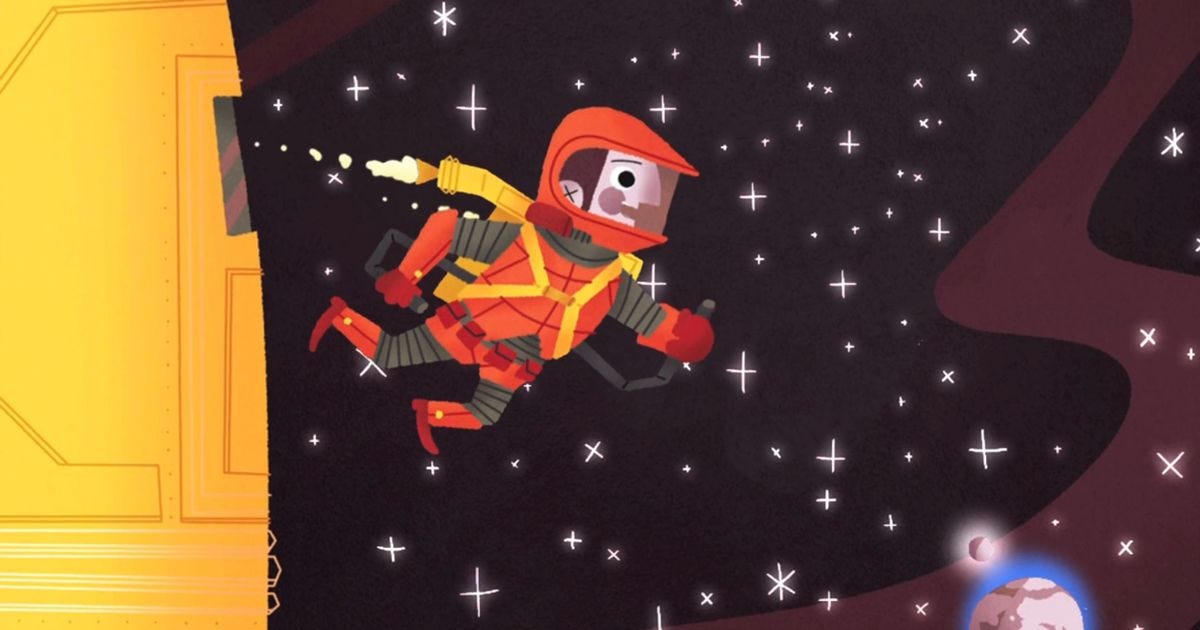
After the colours come the shapes. Interstellar blobs from galaxy-sized lava lamps floating around him. Pyramids, cubes, hypercubes, a flock of hypertori, the odd amplituhedron, a Killing form of E8 Lie groups (exceptionally simple ones), Calabi-Yau manifolds and other geometric extravaganza. All in all, it’s space, Jim, but not as we know it.
In a flash, the stars appear against a jet-black background, but then the sky becomes the colour of an old-fashioned TV tuned between two channels, a chaotic coalescence of white/grey/black pixels that randomly change position as a crackling white noise fills the vacuum.
—reset failed— a cold, emotionless voice states —try again—
A kaleidoscopic sequence of events appear like the history of the Universe flashing before one’s eyes, evolution in fast-forward and progress’s acceleration accelerating, while a soaring siren keeps rising in frequency until it exits the upper hearing threshold. Then, almost with a whimper, the night sky returns complete with the Milky Way, Earth, Moon, and stars in familiar constellations. A Starchild floats into view (Gaye couldn’t help herself) amidst a swarm of shining black monoliths with perfect 1-4-9 proportions. Major John tries to assimilate it all with a blank stare.
“Major John to Mission Control,” Major John says with a sing-song voice. “I can’t hear you.”
“Here I am floating around my tin machine,” Major John chants, “far above the moon.”
“I can’t hear you,” Major John chants as the pandemonium around him intensifies. “And there’s nothing I can do.”
A white wormhole like a Stargate appears into view and Major John floats towards it, even if the audience experiences the illusion of the Stargate moving towards the static Major John. As the Stargate swallows Major John, the whole theatre is filled with the psychedelic dreams of an LSD addict, the embodiment of the improbable, the impossible and the unknown. His trek through the gate is accompanied by a sonic swirl of hypnotic rhythms, mesmerizing melodies and ubiquitous overtones. The sensory overload threatening to overwhelm everybody everywhere all at once until—anticlimax—Major John finds himself in a stark white room with glowing white floor tiles and decidedly Victorian furniture. It makes no sense.
Stroboscopic lights abound as Major John takes off his helmet and his face ages with each flash. Then the process reverses and Major John becomes younger, smaller until there’s only a naked baby on top of a crumpled space suit. Then the baby rises, is enveloped in a cocoon and becomes the Starchild. Shining black monoliths appear from all directions at once and form a protective swarm around the Starchild as the lot of them move up, up, up, through the ceiling and away.
For a few moments, a stunned silence reigns. Then the audience bursts with applause and cheers.
👁👁
“Would you be interested in a coffee?” Gaye asks backstage as she helps Dorian out of his costume, “I know a nice place right around the corner.”
Unfortunately, she doesn’t quite get the response she hopes for as Dorian fails to see her warm smile and the desire in her eyes, but rather catches her wild hair, her grimy Meme-shirt and baggy jogging trousers. But before he gets a chance to answer, Medusa pulls him away.
“That was fine, but we have a new set tomorrow,” she says as her severe stare nails Dorian. “We have a lot of rehearsing to do.”
Scene 2: The Man Who Fell to Earth
The curtains lift, revealing an empty stage. A single spotlight appears, and points to the ceiling. Floating just below it, belly-down, Dorian—wearing red make-up making him look like a cross between a human and an alien—looks down in terror.
“Anti-procrastination scene,” the narrator says, as fast as she can.
Dorian falls down, accelerating as he plummets, screaming all the way.
Boom!
A sound like a meteor impact, a red dust cloud rising from a crater in which a crumpled body lies.
Curtains.
👁👁
Backstage in the one-hundred-seater theatre, Gaye hands Medusa a tenner, confirming she lost the bet.
“Only twenty-one demanded their money back,” Gaye says, “I can’t quite believe it.”
“Told ya,” Medusa says as she takes the spoils. “You can get away with anything if you play it just right. Whaddya say, Dorian?”
“I dunno,” Dorian says. “I’m just happy it was my projection falling and not me.”
Support this writer:
Like this post!
Re-stack it using the ♻️ button below!
Share this post on Substack and other social media sites:
Join my mailing list:
Author’s note: This is the first time I’m posting an unpublished short story1. Not that I didn’t try, as it was rejected forty-two times2. Many thanks for reading, and hope you enjoy it!
Not a novel;
One editor called it an ‘absolutely wonderful story!’, which still wasn’t enough for it to get accepted;