
A Grand Performance
My other sample chapter at the Libraro Prize

—A Grand Performance—
April 7, 586 BC
The Moon, Venus and Mars are in a Grand Trine in Aquarius. In this exceptional conjunction, you will astound everybody and perform great things. Give it your all.
—your daily horoscope—Aquarius;
Babylon, the twenty-second day in the month of Bara.za.gar during the nineteenth year of King Nebuchadrezzar’s reign. Fourth day of Akitu.
The plaza in front of the Temple of Ishtar is packed with people. In this case, the visitors are predominantly women: wives with or without their husbands, young unmarried women and girls of all ages—every woman in Babylon (and some from beyond) wants to see the performance today.
Some would say it’s filled to capacity and overflowing. Nobody wants to miss the story of Ishtar, as performed by entu Emuqtu and her troupe. If not the religious, then most definitely the artistic event of the year. On an elevated stage to the right, King Nebuchadrezzar, Queen Amytis and their children are seated. Despite Amytis’s rivalry with Emuqtu, they are here because even the king’s children—in particular, his daughters—did not want to miss this at any cost. In this case, Nebuchadrezzar prefers to face the devil in his wife rather than the deep blue sea of despond from his children. And even Queen Amytis must admit that Emuqtu and her troupe put up a phenomenal act, second to none. Emuqtu knows this, of course, and ensures that the royal children have the best seats, slightly above the immense crowd.
As word got out after the first time they performed this—when the plaza was half empty—the crowd grew every year, helped by the way the performance was improved every time, and theatrical innovations were introduced, such as curtains before the show, painted backgrounds, increasing musical accompaniments, and a choir singing the narration. It’s become the event of the year, not openly—officially, the main events centre around Marduk and Etemenanki—but everybody ‘in the know’ (an audience that grows every year) is aware of the true highlight of Akitu, which is a play for the whole family. So families—mainly from Babylon, yet quite a few come from across the kingdom and beyond—arrive early to get the best view, filling up the plaza of the Temple of Ishtar already early in the morning.
This presents an opportunity for another type of attendee. So even in this jam-packed crowd, vendors and other salespeople somehow make their way through, loaded—but not for long—with food, drinks, and all kinds of souvenirs and memorabilia.
“Exquisite Emmer, the best beer of the kingdom,” one vendor shouts. “Nice and cold. Only two shekels.”
“Ishtar dolls,” a female artisan clamours, “Intricate, beautiful and top craftswomanship. Your daughters will love you forever.”
“Spicy goat meat,” another vendor yells, “tastiest in Babylon. Only three shekels.”
“Celestial bracelets,” a female vendor bellows, “inset with lapis lazuli. Your wife’s gratitude will be endless.”
“Artisan cheese from Nippur County,” the next salesperson roars. “Accept no substitutes. Smooth until the bitter end.”
“Ishtar scarves,” another female vendor shouts, “in any colour you like. Original craftswomanship from the famous Uruk ateliers.”
“Red wine, superb red wine from the Shiraz grapes of Persis,” a wine vendor yells. “A feast for the true connoisseur.”
They all do brisk business on this balmy morning as the temporary stage in front of the Temple of Ishtar is hidden behind a lattice from which a dark curtain hangs. It obscures the stage, which gradually fills with actors & props, dancers & costumes, musicians & instruments. Once the actors and dancers are in position, a serene melody escapes from a dozen flutes, signifying that the play is about to begin. The crowd—who were chattering vividly—immediately fall silent in gleeful anticipation. A few strong stagehands remove the curtained lattice to unveil a priestess dressed up as a mistress of ceremonies.
“Ladies and gentlemen, girls and boys,” the female announcer, Priestess Shala, who’s dressed like a dualistic Sun/Moon goddess, says, loud and clear, “are you ready for the incredible story of Ishtar—goddess of love and war—as she descends into the Nether World?”
The crowd yells “Yes!” with an earth-shaking volume.
“Ishtar can’t hear you,” Shala the Shamash/Sīn substitute says. “And if she can’t hear you, she won’t come. Are you ready?”
The next “Yes!” is even louder than the first one, while girls and women squeal and scream at the top of their lungs with notes so high and loud they shatter glass. Still, Ishtar isn’t happy.
“Are you sure?” the mistress of ceremonies teases as she shakes the white feathers on her left and the dark feathers on her right. “Are you really ready for the story of Ishtar’s descent into the Underworld?”
The crowd goes wild, and the noise reaches deafening levels. Young girls and boys scream and shriek with high-pitched notes so intense they swirl around the whole inner city of Babylon. The anticipation is off the scale as the excitement threatens to go beyond. For so many young kids and adolescents, the year-long wait is almost over.
A burning rag wrapped around a stone flies through the air in a perfect arch, accompanied by a steep crescendo and diminuendo of the flute choir. It’s launched from behind the temple building and lands on the stage, only a few feet from Emuqtu—who jumps on the stage from behind a curtain—symbolising the descent of Ishtar from the Heavens. The crowd cheers and applauds. The slinger who throws the ‘burning star’ is one of the best in the kingdom, as it always lands right next to Emuqtu and—god forbid—not in the crowd. The only reason she’s not enlisted in Nebuchadrezzar’s army is that she is female. This opening act never fails to charm the public. As the burning rag hits the floor, a rumble of drums fills the air, and Emuqtu begins to dance.
She’s trained hard for this every year, and while some of her dancers are better movers and some have more voluptuous bodies, none have Emuqtu’s charisma. Flutes blow happy melodies, Sitars play excited arpeggios, and the drums beat pulse-pounding rhythms as Emuqtu swirls across the stage. This is the Dance of Ishtar and Her Friends.
Emuqtu whirls to stage left and pulls a female dancer onto the stage, who joins the dance. Emuqtu moves to stage right and pulls another dancer on the stage, who joins the party. She repeats this until she is accompanied by sixteen dancers who move in perfect synchronicity as the music builds to the crescendo of the overture. The dancers she’s pulled up the stage are the main characters of the story: Ninshubur, her faithful sukkal; Neti the Gatekeeper of the Underworld; Erishkigal, the Queen of the Underworld; her vizier Namrat; the Seven Judges of the Nether World; Enki, the Trickster God; Kurgarra and Galatur; Ishtar’s husband Tammuz; and Belilli, Tammuz’s sister.
The choir in the back now sings about Ishtar. She is the goddess of love, and she’s capricious—it’s why she’s had numerous lovers before she married Tammuz. She is also the goddess of war and has helped King Nebuchadrezzar as he fought the Assyrians, the Egyptians and the Judeans. She is the goddess of fertility—without her, the cows will have no calves, the donkeys no foals and, indeed, the humans no babies. She is the goddess of grain—without her, there’s no bread and cereals. She is the goddess of prosperity—Ishtar is always working to lift everybody from poverty and need.
Finally, Ishtar is incurably curious. She is so curious that at a young age she went to Eridu and stole ‘Mej’s from Enki, because she wanted to know what they are, and what they do. ‘Mej’s are spiritual qualities like truth, wisdom, falsehood, attention and holy purification; divine states like godship, kingship, ladyship, heroism, eldership, shepherdship and literacy; sacred objects like the Crown, the Throne, the Sceptre, the Shrine and the Royal Insignia; creative attributes like art, music, and various crafts; and intense emotions like fear, weariness, terror, lamentation and enmity.
Ishtar is also full of wanderlust, travelling the earth, the sea and the sky. Yet there is one place Ishtar has never been: the Underworld. Many say the Underworld is a dark and forbidding space where the souls of the dead go to rest. Others say it is a place where demons torture those who dare enter it. But Ishtar is not afraid, because her older sister Erishkigal is the Queen of the Underworld. Surely she can go visit her sister?
Yet, she is also careful. She asks her sukkal Ninshubur to alert the other gods if she does not return after three days and three nights. Then, Ninshubur should first approach Enlil, and if Enlil does nothing, go to Sīn and finally, as a last resort, try Enki. “Raise a catastrophe of lamentation,” Ishtar tells Ninshubur. “Beat the drum of the Assembly Seat, visit the residences of the gods one by one. Tear your eyes, tear your mouth, tear your provocative hip.”
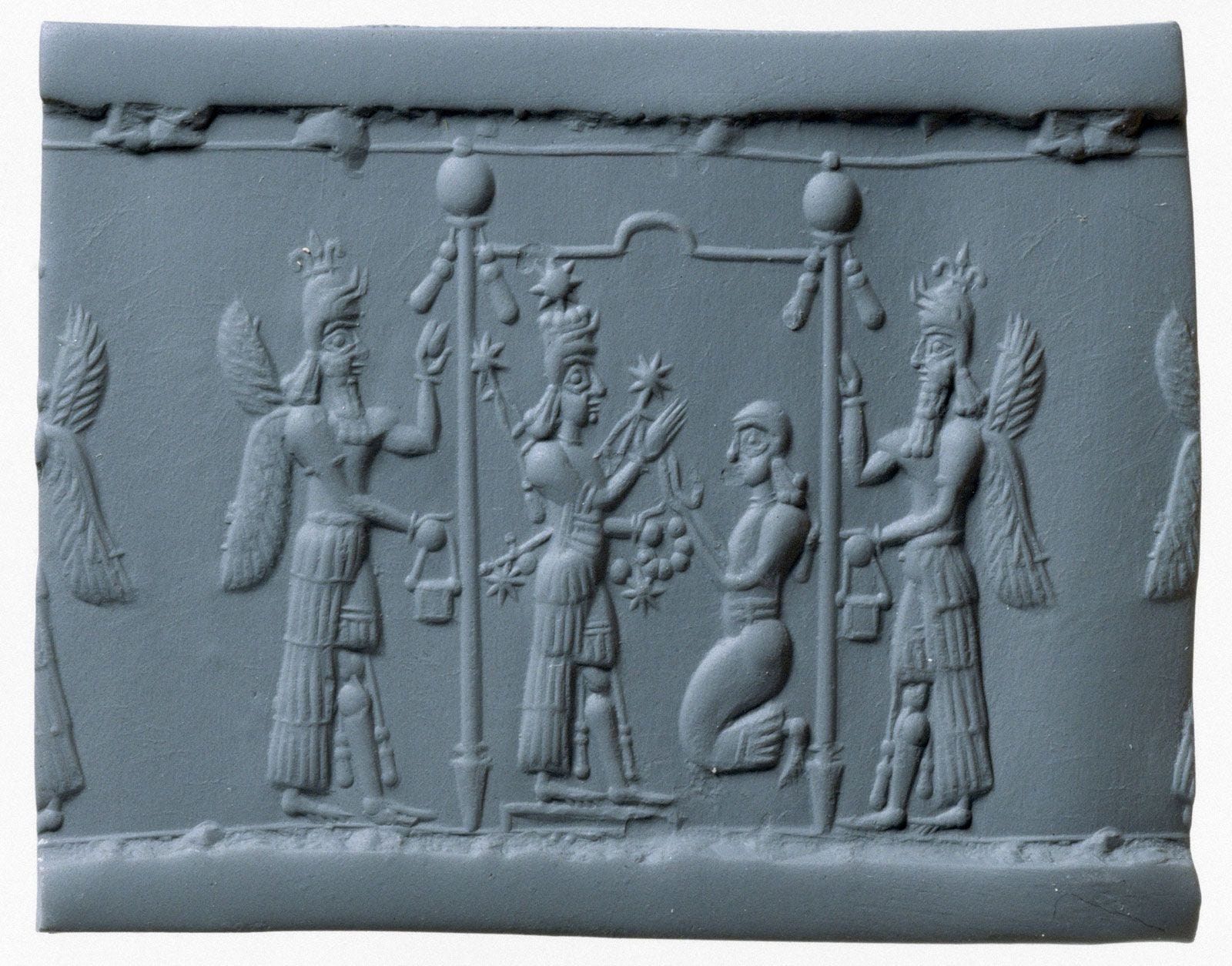
Also, before she goes, she arms herself with seven major ‘Mej’s, encapsulated in her garments. “Help me dress, my dear Ninshubur,” Ishtar says. “Hand me my Seven Holy Aspects.” One by one, Ishtar puts on:
The Royal Robe expressing her personal divinity;
The Silver Anklets of Athleticism powering her dance moves;
The Golden Bracelets, symbols of binding agreements;
The Breastplate of Seduction expressing her intense passion;
The Necklace of Charisma with which she charms her way;
The Sceptre—the holy measuring rod and line—that measures out justice;
The Crown embodying her authority;
Now, she is ready and heads off to the Underworld. Emuqtu—impersonating Ishtar—exits stage left as the stagehands place a new background painting depicting an immense steppe with huge mountains in the back. Emuqtu comes back on stage and walks ‘The Path of No Return’, accompanied by eerie flutes and nervous sitars. The tension builds as she goes deeper into the unknown, until she encounters a mob of demons.
The overture starts as the play goes into overdrive. The drummers pound polyrhythmic patterns mimicking the dance of the dead. Strumming sitars sweeping accelerating arpeggios in circuitous crescendos. The choir chants eerie melodies like ghosts on the run. The demons—epic connoisseurs recognise Lamashtu, Kugallu, Asag, Sadu, Namtaru, Neti, and the six Red Serpents—begin to dance with sinuous, devilishly delicate moves, like stygian waves on a wine-dark sea. The crowd cries out in euphoria and anxiety.
The demons dance in circles, surrounding Ishtar. But Ishtar won’t be caught that easily. She strikes with her Sceptre, and a Red Serpent goes down. Under loud encouragement from the enchanted audience, Ishtar makes a cartwheel through the opening and escapes the gang of demons. But the demons won’t let her go and surround her once more.
Noticed by only a few, an impromptu crane has been set up at the back of the stage. As Emuqtu makes a quick exit stage right, a stagehand connects the harness hidden under her royal robe with a thin yet strong rope. As Ishtar-cum-Emuqtu dances back on the stage, in the excitement, only a couple of sharp eyes notice the rope from her back rising up to the crane. In the play, Emuqtu strikes down a few more demons, but they still outnumber her and ambush her again.
“We have you cornered,” the throng of demons chant in a basso profundo that reverberates through the crowd. “Surrender.”
“I am Ishtar, Goddess of War,” Emuqtu sings at the top of her lungs. “I will never surrender.”
She bends over and touches her Silver Anklets of Athleticism. Simultaneously, the percussion section rings an arrangement of bells. “Rise,” she sings. “I will rise above you.”
A couple of strong stagehands haul her up as fast as they can, then rotate the crane so that Ishtar—laughing out loud in victory—swings to stage left, where they lower her. The music rises through rambunctious rhythms played at warp speed to one massive, loud pandemonium as Ishtar jumps to safety. The demons look up in exasperation as the crowd goes wild.
This stunt is new—performed for the first time during this Akitu—and the noise erupting from the audience washes over Babylon. King Nebuchadrezzar’s jaw drops in sheer admiration. He gazes at his wife, Amytis, who can barely believe her own eyes, and then they both rise to give a standing ovation. Their children were already jumping for joy, anticipation and sheer exhilaration.
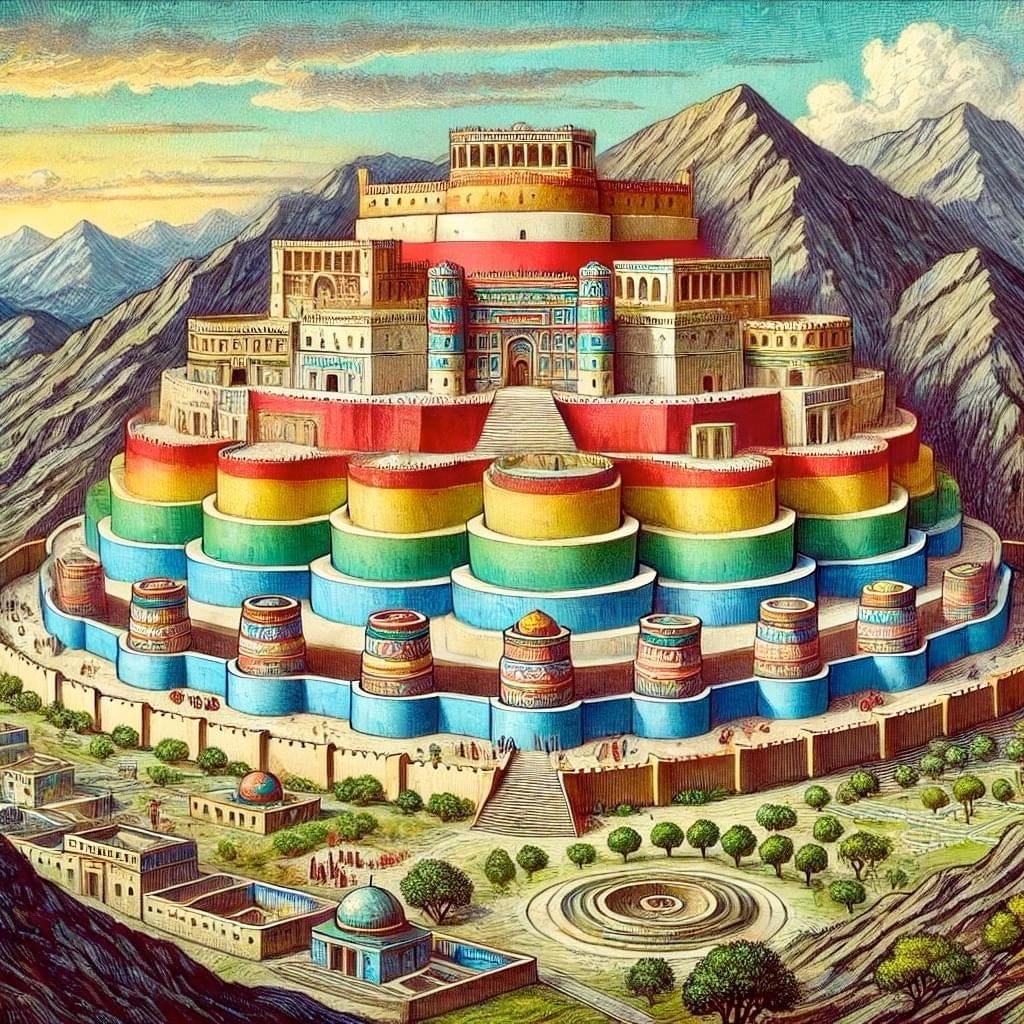
With another quick background change, a painting of a huge castle with seven concentric walls and seven gates—one for each wall—is set up. One white gate—a light stage prop—is put upon the stage. The walls and the gates have colours:
The First Gate is white;
The Second Gate is black;
The Third Gate is purple;
The Fourth Gate is blue;
The Fifth Gate is green;
The Sixth Gate is silver;
The Seventh Gate is golden;
It is the Castle of Gatir, in which Queen Erishkigal and her husband Nergal reign from the inner palace—which is beyond the Seventh Gate—of lapis lazuli. Inside the dark and dreadful Underworld—symbolised by smoke arising in the back of the stage that is blown (through the action of clothed fans wielded by stagehands) along the sides of the podium—the palace looks daunting. Yet Ishtar is not afraid and knocks on the First Gate.
“Let me in,” she bellows. “I am Ishtar, Queen of Heaven, Goddess of Venus. Let me in.”
Slowly, the gate opens. It is opened by Neti, the gatekeeper of the Underworld.
“What brings you here, dear lady?” Neti says as if he hadn’t seen Ishtar during the rapturous overture. “Last time I checked, you were still alive.”
“I am still alive,” Ishtar says. “I wish to visit my sister Erishkigal. Your boss.”
“Only the dead can enter the Underworld for free,” Neti says. “If you are still alive, you must pay for your passage.”
“But why?” Ishtar says. “I just want to see my sweet sister.”
“It is the way of the Nether World,” Neti says. “To pass this gate, you must give me your crown.”
“My crown is my mej of authority,” Ishtar says. “Why should I give it to you?”
“It is the price of admittance,” Neti says. “You will get it back when you return.”
“Well, I guess I have no choice,” Ishtar says as she is increasingly interrupted by shouts from the crowd, especially those of the children.
“It’s a trick,” one of them says.
“Don’t give the crown, Ishtar,” another one says.
“Keep your crown and slay him,” a more fanatic one says. “And then go in.”
But Ishtar cannot slay Neti, because who else will open the other six gates? So, reluctantly, Ishtar hands her crown to Neti.
“Thank you,” Neti says and opens the gate for her.
During this last exchange, the stagehands quickly replace the background painting of Gatir’s castle with one of the Sixth Wall—the black one with the Black Gate—and the white gate with a black one.
Again, Ishtar knocks on the gate and demands to be let in. Again, Neti appears and says: “You want to go through this gate, too?”
“Of course,” Ishtar says. “My sister Erishkigal lives in the lapis lazuli palace inside the First Gate. You know that.”
“If you want to pass this gate,” Neti says. “You must hand over your Sceptre.”
Again, children in the audience cry out, telling Ishtar not to do it. Emuqtu sometimes looks into the crowd, as if she can hear their words, which causes even more children to cry out. She loves playing the audience like this, yet her role requires that she must give her Sceptre to Neti, as well.
And so it goes: at every gate, Ishtar must hand over another of her sacred mej’s. The youngsters in the crowd shout, scream and beg her not to do it, but every time Ishtar acts as if she can’t hear them, and hands over, in succession, her Necklace of Charisma, her Breastplate of Seduction, her Golden Bracelets, her Silver Anklets, and—finally, as the cries of despair from the crowd reach peak intensity—her Royal Robe. Wearing only her underskirt, she enters the lapis lazuli palace to confront her older sister.
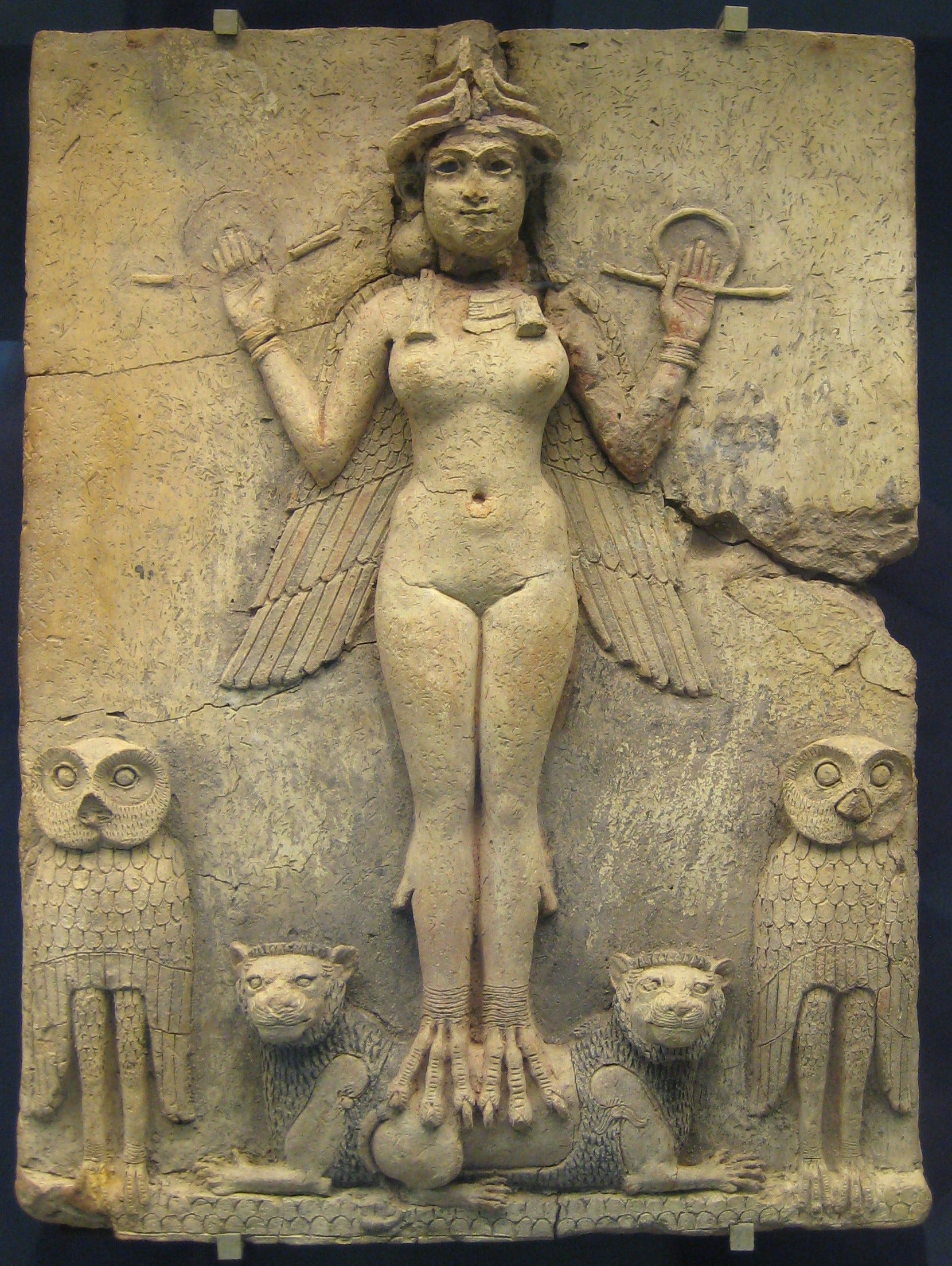
“What are you doing here?” Erishkigal says. “This is the Underworld. You are alive. You cannot enter here on a whim.”
“I only want to visit you, dear sister,” Ishtar says. “I haven’t seen you in ages.”
“You cannot just see me,” Erishkigal says. “Ever since I married Nergal and became Queen of the Underworld, I must stay here, and nobody alive can see me. It is the way of the Nether World.”
“That’s stupid,” Ishtar says, defiantly, “One should always be able to visit family.”
“I don’t believe that you are here just to visit me,” Erishkigal, who is getting angrier by the minute, says. “You are here to take over my realm.”
“This dreary place?” Ishtar pulls a face. “No, I’m here to visit you. And maybe see what’s going on in here. You know I am curious.”
“You lie,” Erishkigal says. “And you must be dead to be here. So I will kill you.”
These last words are followed by a highly audible gasp from the audience. “No!” Many children say in disbelief.
“You cannot kill me,” Ishtar says. “The gods will know, and our father Shamash will come down with fire and set this place alight.”
This gives Erishkigal pause. She looks around and then says to her vizier, Namrat: “Namrat, unleash the Sixty Diseases upon her.” This way, she will not have killed her sister directly.
Namrat obeys and summons the Sixty Diseases. From all directions, sixty dancers disguised as the Sixty Diseases enter the stage. Bedlam ensues, and not just on the stage, as many children cry in horror and many other children shout encouragement to Ishtar. Ishtar fights off a few of the diseases, but because she has given away her seven mej’s, she doesn’t have much power. The music reflects this, as it is more laidback and less exuberant. Tones of distress, downbeat chords and despondent notes foreshadow the inevitable. Eventually, after putting up a courageous fight, the diseases overcome her and she succumbs and falls on a couch, and then dies.
Every single child in the audience—and quite a few adults—cry out in horror and despair. Ishtar is dead. What now? They don’t get time to think as the curtains fall while the stagehands change the scenery, and they re-open, showing that the play is back in the realm of the Heavens.
#
In the Heavens, three days and three nights have passed since Ishtar went into the Underworld. Her faithful sukkal Ninshubur—played by Priestess Shala—is very worried and dresses down in an old, dirty sackcloth. “Ishtar has not returned,” she says. “What should I do?”
“Go to Father Enlil,” the children in the crowd shout. “He must help Ishtar.”
She beats the drum at the Assembly places. She has tears in her eyes, tears at her mouth, tears at her hair and shakes her voluptuous hips as she goes to Nippur and visits the Temple of Enlil. She cries: “Oh Father Enlil, do not let your daughter be put to death in the Underworld.”
But Father Enlil does not offer help. Instead, he becomes angry: “My daughter craved the Great Above. Ishtar craved the Great Below. She who receives the mej of the Underworld does not return. She who goes to the Dark City stays there.”
Enlil’s statement is met with a loud “Booooh” from the crowd. Yet he folds his arms, stabs his chin forward and remains adamant.
So Ninshubur goes to Ur and visits the Temple of Sīn. She sheds thick tears, droops her mouth in lament, tears at her soiled sackcloth and cries: “Oh Father Sīn, do not let your daughter be put to death in the Underworld.”
But Father Sīn is not impressed. “It’s just her silly ploy that helps destroy the destiny of men. Forget about her silly whim, it doesn’t fit my plan.”
If possible, the crowd boos Father Sīn even louder than Father Enlil. But, like Enlil, he only becomes more stubborn as he shakes his head and balls his fists.
Now Ninshubur only has Father Enki left. She goes to Eridu and visits the Temple of Enki, as the tears in her eyes are now real, and she tears at her mouth and hair in utter despair, and beats the door of the temple like a drum.
Father Enki—Shibtu’s husband Adapa reprises his role from the “How Ninmah and Enki Created Humans” play the day before—appears, looking perturbed. “What do you want?”
Ninshubur enters the holy shrine and laments:
“Oh Father Enki, do not let your daughter
Be put to death in the Underworld.
Do not let your bright silver
Be covered with dust of the nether world.
Do not let your precious lapis
Be broken into stone for the stoneworker.
Do not let your fragrant boxwood
Be cut into wood for the woodworker.
Do not let the Holy Priestess of Heaven
Be put to death in the Underworld.”
Father Enki says: “What do you say? What has happened?”
“Ishtar has gone to the Underworld, Father Enki,” Ninshubur says. “She’s gone for more than three days and nights. I am so worried.”
“Ishtar, Queen of All the Lands,” Father Enki says. “Holy Priestess of Heaven. I am troubled, I am grieved.”
He contemplates a bit—Enki is the smartest of all, the trickster of gods, the fixer of their problems—and then brings forth dirt from under the fingernails of his right hand. He drops the dirt on the floor, and miraculously—through a hatch in the stage floor—an androgynous dancer dressed up as Kurgarra appears.
“Who are you?” Father Enki asks as his brows furrow in wonder.
“I am Kurgarra,” the androgynous dancer, adorned with the wings of a bat, says. “I am neither male nor female. The demons cannot see me.”
Then he brings forth dirt from the fingernails of his left hand, and drops it on the floor and just as miraculously, another androgynous dancer appears.
“And who are you?” Father Enki enquires as he scratches his large nose.
“I am Galatur,” the androgynous creature who is also adorned with bat wings, says. “I am neither female nor male. I am invisible to the demons, too.”
Father Enki gives the food of life to Kurgarra and the water of life to Galatur. He orders them to enter the Underworld, pass the seven gates through cunning and subterfuge, and go to Erishkigal.
“Erishkigal will be riddled with guilt,” Father Enki says, “which manifests within her as the pain of birth. She will cry out in agony.”
“Poor Erishkigal,” Kurgarra says. “So what do we do?”
“She’s not really suffering,” Father Enki says. “Her conscience has caught up with her. Now empathise with her pain.”
“Cry out when she cries out?” Galatur says. “We can do that. Shared pain is lessened pain.”
“She will be pleased and offer you a reward,” Father Enki says. “Ask her for the corpse on the couch—that is Ishtar. Then sprinkle Ishtar with the food and water of life.”
#
Kurgarra and Galatur descend into the Underworld. Unlike Ishtar, they are not chased by demons. They reach the First Gate unperturbed and knock on it, while otherwise staying silent. Neti opens the door and says: “Who is there?”
Kurgarra and Galatur stay silent as Neti looks around but fails to see them. “Strange,” he says as he scratches his ugly head. Before he can close the gate, Kurgarra and Galatur flap their bat wings and fly through the opening, as silent as they are invisible. On stage, the actors playing Kurgarra and Galatur make their fake bat wings flap through a hidden mechanism under their robes and jump daintily through the open gate as the actor impersonating Neti pretends not to see them. The young ones in the audience cheer them on: “Go Galatur, go Kurgarra,” they shout. “Free Ishtar.”
And so the two androgynous entities make their way through the Seven Gates, fooling the unseeing Neti every time, to the great amusement of the excited children. Before they know it, they enter the throne room of the Queen of the Underworld, where Erishkigal is writhing in pain, like a woman about to give birth.
No linen is spread on her body. Her breasts are uncovered. Her hair swirls around her head like snakes. “Oh,” Erishkigal moans. “Oh, my inside.”
“Oh,” Kurgarra and Galatur cry. “Oh, your inside.”
“Ohhh,” she moans. “Ohhh, my outside.”
“Ohhh,” they cry. “Ohhh, your outside.”
“Oh, my belly.”
“Oh, your belly.”
“Oh, my back.”
“Oh, your back.”
“Ah, my heart.”
“Ah, your heart.”
“Ahhh, my liver.”
“Ahhh, your liver.”
Erishkigal stops and looks at them. Because she is no demon, she can see them. “Who are you?” She asks. “Moaning, groaning and sighing with me?”
“If you are gods, I will bless you. If you are mortals, I will give you a gift. I will give you the water-gift, the river in its fullness.”
“Sorry,” Kurgarra and Galatur say. “We do not wish it.”
“I will give you the grain gift,” Erishkigal says. “The fields in harvest.”
“No,” Galatur and Kurgarra say. “We do not wish that, either.”
“Speak then,” Erishkigal says. “What do you wish?”
“We only wish the corpse that lies on the couch,” Kurgarra and Galatur say.
“The corpse belongs to Ishtar,” Erishkigal says.
“Whether it belongs to our queen, whether it belongs to our king,” Galatur and Kurgarra say, “that is what we wish.”
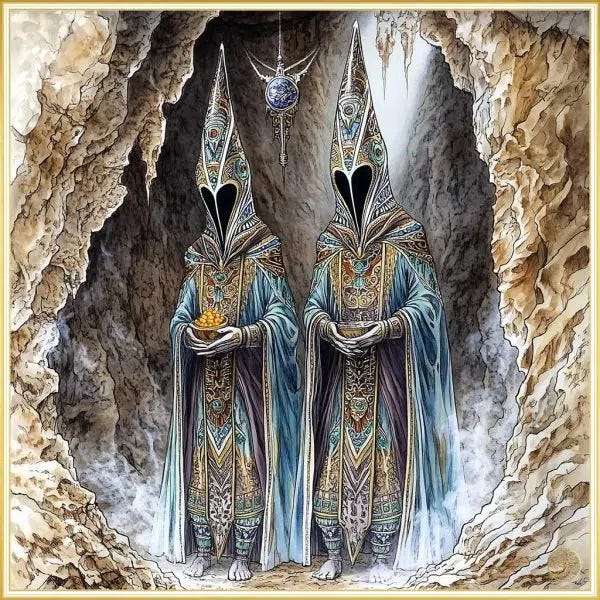
Ishtar’s corpse is given to them. Kurgarra approaches the dead Ishtar and sprinkles her body with the food of life. Then, Galatur approaches the deceased Ishtar and sprays her body with the water of life. Ishtar’s body twitches, her eyelids twinkle, and her head shakes. Then, finally, she opens her eyes and arises . . .
The crowd erupts with loud cheers, ecstatic cries and ovations.
Ishtar gets up and turns around to make her way out of the Underworld. But before she can get underway, the Annuna—Seven Judges from the Underworld—appear and surround her.
“No one ascends from the Underworld unmarked,” they say. “If Ishtar wishes to return from the Underworld, she must provide someone in her place.”
Still without her seven magic ‘mej’s, Ishtar has no choice but to accept their judgment. To ensure Ishtar’s compliance, she is accompanied by the galla—demons from the Underworld who know not food nor drink, who accept no offering, drink no libations, and accept no gifts. They enjoy no love and have no sweet children to kiss. They cling to Ishtar as she makes her way out of the Underworld.
She walks towards the Seventh Gate, and Neti opens it for her. “Goodbye and good riddance,” Neti says. “Don’t let the gate hit you on your way out.”
“No, Neti,” Ishtar says. “You still have my Royal Robe. Give it back.”
“Oh, if I must,” Neti says as he’d hoped she’d forgotten about it. “Here it is.”
Ishtar puts on her Royal Robe and begins to feel much better. Yet the galla cling to her, and she cannot remove them. Sighing in frustration, she walks to the Sixth Gate, which Neti is already opening for her.
“The way out is the way in,” Neti says. “It’s been nice knowing you.”
“Don’t act stupid, Neti,” Ishtar says while eyeing him sternly, “and hand me my Silver Anklets.”
With reluctance, Neti gives her back her Silver Anklets. Ishtar puts them on and feels her power increasing. Yet she is still too weak to get rid of the galla.
And so it goes. At every subsequent gate, Neti behaves like the most rude and forgetful demon in the Underworld, and Ishtar insists on getting her other ‘mej’s back. And she does, as she recovers her Golden Bracelets, her Breastplate of Seduction, her Necklace of Charisma, her Sceptre and, finally, her Crown. Every time, she feels her power increasing. Yet every time, the galla keep sticking to her like well-chewed Arabian gum.
“You are like ticks,” Ishtar says. “Impossible to remove and sucking my lifeblood.”
“We will stay with you until you fulfil your part of the bargain,” the forward galla says.
The small galla are two feet high and shaped like reeds, while the large ones are four feet high and also shaped like reeds. The galla in front of Ishtar is not a minister, yet he carries a sceptre. The one behind her is not a warrior, yet he carries a mace.
Ishtar—now finally out of the Underworld—returns to her palace, where faithful Ninshubur is waiting in a soiled sackcloth. Ninshubur throws herself in the dust at Ishtar’s feet. “My dear Queen, you have returned,” she says. “I was so afraid.”
“Go back to your palace, Ishtar,” the galla declare. “We will take Ninshubur in your place.”
“No,” Ishtar says—echoed by shocked cries from the crowd—as she fervently shakes her head. “Not Ninshubur. She has given me constant support. She is my sukkal who gives me wise advice. She is a warrior who fights by my side. She did not forget my words as she set up a lament for me by the ruins, beat the drum for me at the Assembly places, cried for me and visited Nippur, Ur and Eridu and their temples. Because of her, my life is saved.”
“I will never give Ninshubur to you.”
The galla then try to take Ninshubur by force, but Ishtar becomes so angry that she unleashes all her powers to protect Ninshubur. Try as they might, the galla cannot touch Ninshubur. “Walk on, Ishtar,” the galla say. “We will accompany you to Umma.”
In Umma, Ishtar’s son Shara is also dressed in a soiled sackcloth. He throws himself to his mother, crying with happiness because she has returned.
“We will take Shara in your place, Ishtar,” the galla proclaim.
“No,” Ishtar cries, getting very angry now. “Shara is my son who sings hymns to me. He cuts my nails and smooths my hair, as he loves me deeply. I will never give Shara to you.”
“Walk on, Ishtar,” the galla say. “We will accompany you to Badtibira.”
In Badtibira, Ishtar’s son Lula wears a soiled sackcloth. He prostrates to his mother, crying for joy at her return.
“We will take Lula in your place, Ishtar,” the galla pronounce.
“No,” Ishtar cries, getting very angry now. “He is my son. Lula is a leader among men. He is my right arm, he is my left arm. I will never give Lula to you.”
“Walk on, Ishtar,” the galla say. “We will go with you to the big apple tree in Uruk.”
In Uruk, by the big apple tree, Tammuz—Ishtar’s husband—is dressed up in his shining ‘mej’ garments and sits on his magnificent throne. Unlike Ninshubur and Ishtar’s sons, he has not been in mourning. He freezes when he sees Ishtar.
Ishtar becomes outraged. She fastens the eye of death on her disloyal husband and enchants him with words of wrath and cries of guilt.
“Take him away,” she says to the galla, shaking with fury. “Take Tammuz away.”
The galla seize him by the thighs, pour milk out of his seven churns and break the reed pipe he’s playing. They make him stand up, they make him sit down, they beat him and gash him with axes.
Tammuz raises his hands to heaven and prays to Utu, the God of Justice:
“Oh, Utu, you are my brother-in-law,
I am the husband of your sister.
I brought cream to your mother’s house,
I brought milk to Ningal’s house.
I am the one who carried food to the holy shrine.
I am the one who brought wedding gifts to Uruk
I am the one who danced on the holy knees, the knees of Ishtar.
Utu, you who are a just god, a merciful god,
Change my hands into the hands of a snake.
Change my feet into the feet of a snake.
Let me escape from my demons.”
But Utu will not listen, and the galla take Tammuz into the Underworld.
#
Yet Tammuz has a sister called Belilli. Belilli loves her brother dearly and cannot imagine being separated from him. She must talk to Erishkigal, yet she does neither have Ishtar’s ‘mej’s and powers, nor the invisibility and bat wings of Kurgarra and Galatur, so cannot get in the Underworld alive. In utter despair, she commits the ultimate sacrifice.
After her death, she is taken to Queen Erishkigal. “You killed yourself so you could take the place of your brother Tammuz?” Erishkigal says in astonishment. “That’s crazy.”
“I love my brother so much,” Belilli says. “I cannot bear to see him dead. Please, Queen Erishkigal, have mercy and return him to Earth and take me in his place.”
“You Upperworlders are bonkers,” Erishkigal says as raucous laughter erupts from the crowd. “What is a Queen to do with people like you. Lemme see, do you have any skills?”
“In the Upperworld, I am a humble scribe,” Belilli says. “I can write cuneiform on parchment and inscribe hieroglyphs on clay tablets.”
“Good,” Erishkigal says. “I’m way behind on my paperwork because I hate it. I’ll make a deal: I will return Tammuz for six months to the Upperworld while you are here doing my paperwork. I’m way behind, and it keeps adding up as people just keep dying, and I have to keep track. It’s impossible to keep up, you know.”
“If it brings back my brother,” Belilli says. “Then I will help you.”
“Yet either one of you must be in the Underworld at all times,” Erishkigal says. “So when you return to Earth for six months, Tammuz will come down here again.”
Belilli thinks hard, because this means she will only see Tammuz when they change places every six months. Yet she does not have Ishtar’s power and figures that this is the best deal she can get. So she nods in agreement.
“Excellent,” Erishkigal says. “You can see your brother this afternoon, after which I will return him to Earth. Then you can start with my paperwork. It’s that little heap over there.”
Erishkigal points to a veritable mountain of scrolls and a hill of clay tablets, but Belilli doesn’t blink. “I will be your scribe, my dear Queen,” she says. “You will not be disappointed.”
#
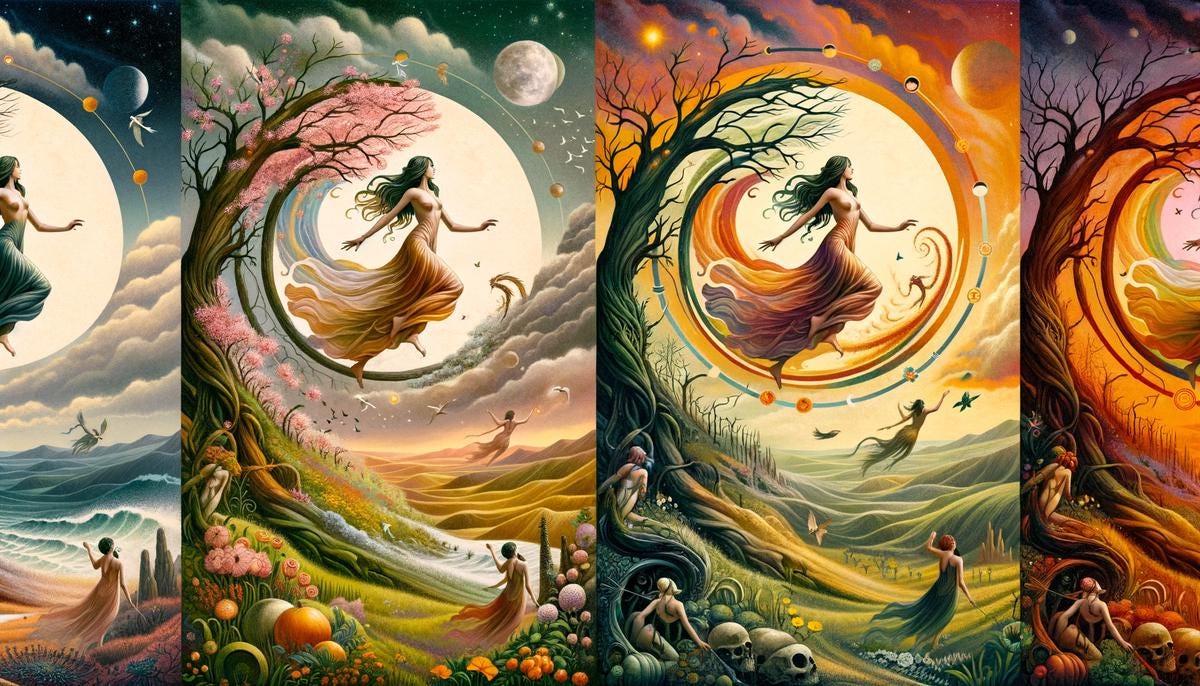
The curtains fall and are opened one final time for the closing act. All players are on the stage and start the Dance of the Change of Seasons. Initially, the dancers wear thick robes in the depth of winter, and shake visibly.
“Cold is the winter,” the choir sings, “as it is the expression of Erishkigal’s wrath which we have to suffer through. But do not despair, because Tammuz is released from the Underworld, bringing spring.”
The dancers shed their thick robes and swirl around in lighter tunics as the background changes from snow-capped mountains to green, lush valleys filled with blooming flowers. A few buckets of water are sprayed over the dancers and the front rows, who accept it with glee.
“Spring arrives with the spring rains,” the choir sings, “and the land becomes fertile. Crops are planted, barley and wheat are sown, and everybody is happy. Soon it will be Akitu.”
The crowd cheers as the lush, verdant background is replaced by a scorching desert. The dancer discard their light tunics and wear only the most minimal of garments. Still, they huff and puff from the heat.
“The summer has come as Tammuz returns to the Underworld and Belilli comes back to Earth. Erishkigal is hiding, as now Shamash reigns supreme. It is hot, very hot, yet the strong sunlight makes the crops grow, preparing them for harvest, while the humans can seek cooling in the rivers and baths.”
The summer ends as the leaves in the trees change colour and the harvest is sown. Again, a few buckets of water are sprayed over the dancers and the front row, who welcome the cooling effect as the water evaporates.
“Autumn and its rains are upon us as we reap the harvest,” the choir sings. “We must keep some of the food to carry us through the winter. Grain is stored, grapes are harvested, and wine is made as we rejoice.”
But soon the pleasant autumn gives way to the chill of winter as the dancers begin to shiver in the cold and quickly don some thick robes and dance fervently to keep warm.
“The winter returns, but it won’t be long until Tammuz returns to Earth to bring spring,” the choir sings.
“And Belilli comes back to do my paperwork,” Erishkigal sings as the crowd cheers, amused. “Without her, I’d become just as crazy as you Upperworlders.”
Then, one by one, the dancers exit the stage until only Ishtar is left. She is clothed with her full regalia: her Royal Robe, Silver Anklets and Golden Bracelets. Also, her Breastplate of Seduction, her Necklace of Charisma, together with her Holy Sceptre and Heavenly Crown.
“This was the story of Ishtar’s descent into the Underworld,” she says as the crowd replies with a deflated “Ooooh,” as they know the play is coming to its end.
“It reminds you that curiosity is good,” Emuqtu, dressed up as Ishtar, says. “But that you can also go too far. So think hard before you do something crazy.”
“Ishtar, Ishtar,” the crowd cheers and applauds.
“Trust your friends and confidantes, as they may save your life,” Emuqtu says. “And you might save theirs.”
“Friends,” the crowd shouts. “Friends forever.”
“And it is through faithful Belilli’s sacrifice that we have the different seasons,” Ishtar says. “That brings so much good, and sometimes also bad tidings, through which we must learn to live.” The shouts of “Ishtar, Ishtar,” keep coming.
“I hope you have learned a lot,” Ishtar says, “and that you will remain curious. Seeking knowledge is good. But now I must return to the Heavens.”
“No,” the children cry. “Ishtar, stay with us.”
“I love you all, but I can’t,” Ishtar says. “I am a goddess, so I must return to the sky. Take care, be good people, and if you look up tomorrow before sunrise, you can see me rise from the East.”
“We will pray to you, dear Ishtar,” the majority of the crowd promises. “We love you.”
“And when—later in the year—I am not in the morning sky,” Ishtar says. “It means I am visiting my sister Erishkigal in the Underworld.”
“Noooo,” the children cry out. “Don’t go.”
“I must,” Ishtar says. “But I will come back. Every time. Keep checking the western sky at dusk, and you will see me return.”
“Yes,” the children say in unison as they start to clap.
“Unfortunately, I must go,” Ishtar says as she takes the deepest of bows. “But remember, I will return. Always.”
Then the impromptu crane lifts her up as high as it can—gently, slowly, while Emuqtu puts her left foot on her right knee and flaps the faux wings on her back—as the people on the plaza erupt in a final bout of cacophony. Even as Emuqtu has been lowered behind the stage, the applause lasts for long minutes afterwards.

Support this writer:
Like this post!
Re-stack it using the ♻️ button below!
Share this post on Substack and other social media sites:
Join my mailing list:
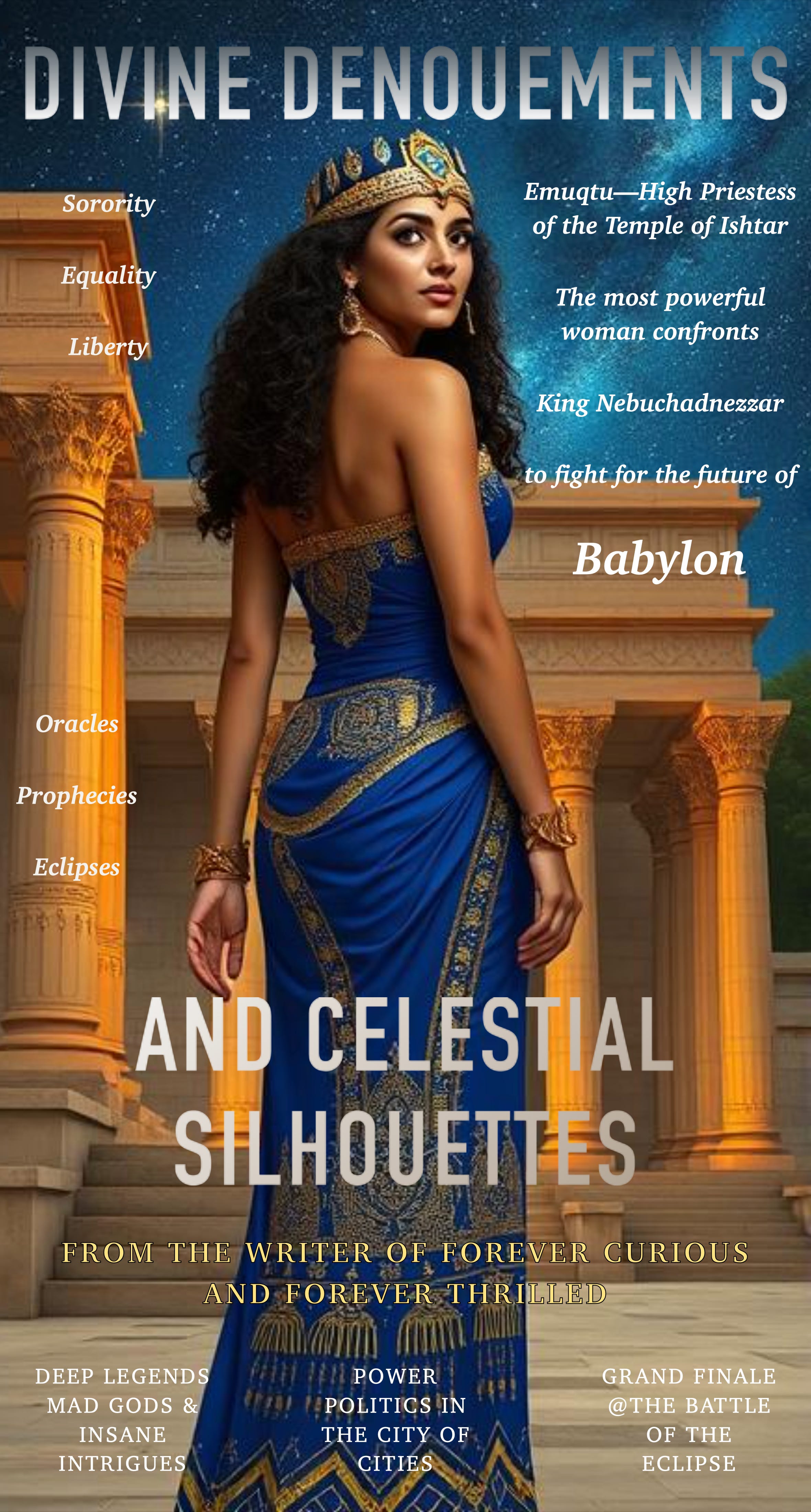
Author’s note: I’m quite unhappy with the looks—in particular the copy-editing looks—of this sample chapter in the Libraro Prize competition (I hope the link works). I’m partly to blame, as there was the option of correcting that while I posted it. What happened was that the first sample chapters looked good, so I assumed the other one would be OK, as well.
Wrong: ‘assume’—as one of my colleagues used to say—makes an ass out of u and me. Especially in the second sample chapter, all the opening curly quotes are replaced by %, and my bullet point lists end up empty. Now I’m afraid to edit and re-enter it, because I don’t know if this will delete the few comments that it has attracted so far.
Another lesson learned: always check everything!
You could register at the Libraro Prize, then search for my entry: Divine Denouements & Celestial Silhouettes and then leave a comment, if you wish. But I do realise it’s quite an arduous process. Oh well, you live and you learn.
Welcome to new followers and many thanks for reading!