
Blue—Red—Green, Part 2
At the lab and at the museum

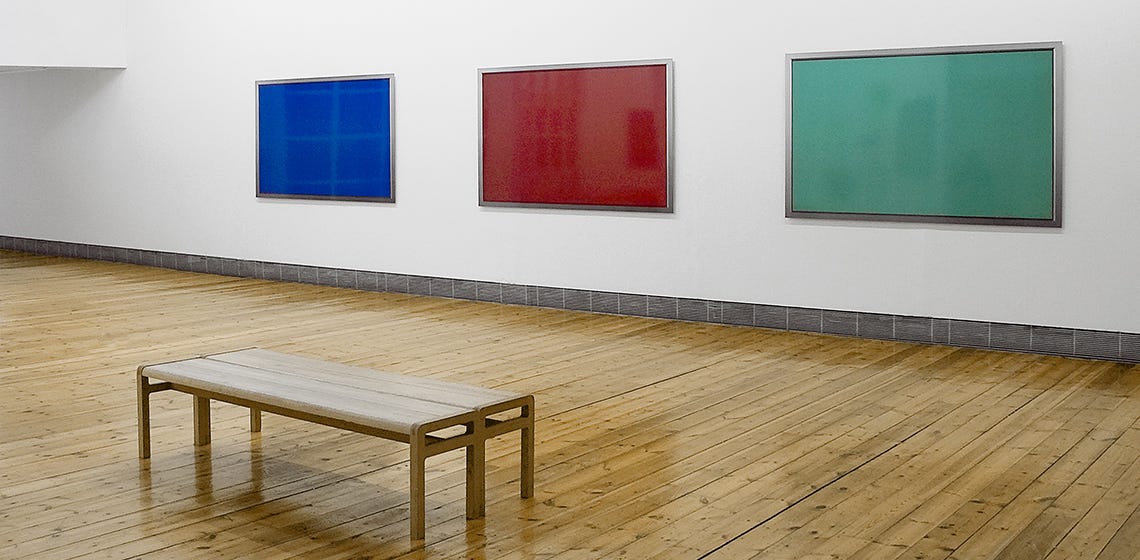
One hour later than planned, George Kwanju arrived at the University of Oxford’s research lab. He’d immediately reported the wrong prescription, then waited until the correct one arrived, together with a large package from Japan that George couldn’t remember ordering. He decided to wonder about that later. Arriving too late stressed him considerably—although not as much as it used to—and leaving without his medication was no option. Forced to choose between the devil and the deep blue sea, George braved the uncharted waters.
His colleagues at Oxford Quantum took his late arrival in stride, greeting him warmly. They ran a few extra tests and tried to fine-tune the tunnelling microscope while waiting for George. And when George did make it, they didn’t rush him, either, as they needed George to be calm.
“A cup of Darjeeling, dash of milk?” His colleague Simon asked, knowing exactly how George liked his tea, as he never deviated.
“But only just a dash,” George answered, as always.
It was a ritual, alright, but a ritual meant to soothe George, to get him in the right mood before the readings. While it might drive some of them bonkers in life outside the lab, the scientists of the tunnelling microscope team actively appreciated George’s predictability. ‘Definitely more predictable than the stuff we study,’ one of them had said under his breath.
For today’s observation, they had prepared a sample of chlorophyll. An old-fashioned electron microscope was used to pinpoint the location inside a chloroplast where the most mysterious part of the photosynthesis process took place—the FMO protein where quantum entanglement plays a major part. The electron microscope was merely an aiming device for their prototype—the Quantum-Tunnelling microscope—which could zoom in on actual quantum processes.
As George finished his tea, his colleagues prepared his stereoscopic goggles which were connected to the QT-microscope and the easy chair for George to sit in as he performed his observations. Thick black letters reading ‘Quantum Exegesis’ were braided into the red chair’s headrest, initially in jest—even if George didn’t understand the joke—but increasingly taken in all seriousness.
Admittedly it was rather meta, using a quantum tunnelling microscope to observe a quantum entanglement process. Yet the researchers at Oxford Quantum were sure that if they didn’t do it, someone else eventually would. They wanted to be the first, both at observation and—obviously—at publication. Ironically, George was their window into the quantum world.
The moment of truth. George was ready, the QT-microscope warmed up, fine-tuned and aimed at the correct position. George put on his goggles, the connection to the QT-microscope established and the focus increased. Inadvertently, most of them—George excluded—held their breath until George descended into his so-called hypercube and started to talk.
Planck windows, communiqués
Stitched straight into space
Until they’re in phase
Ethereal condition
Transparent exclusion
Decoherencent suppression
Singular connection
Quaint quasi quaternion quarantine
Extra-dimensional phenomena
Quirky quantified quasi quatrains
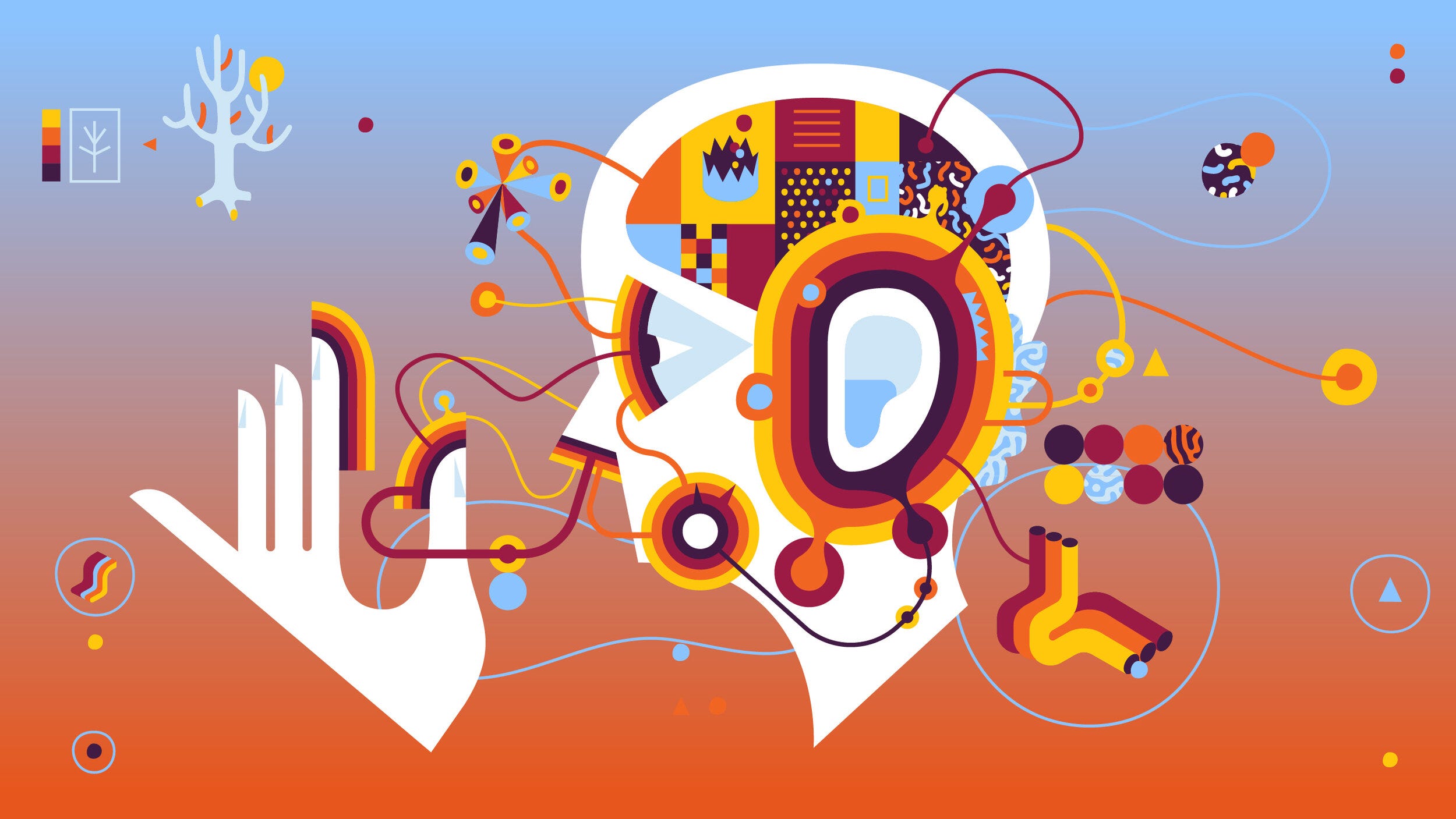
The unpredictably varying frequencies, random interactions and inscrutable phenomena at the quantum level were never meant to be observed by human senses. The differences in scale, periodicity and environment were too vast, as the human sensory system too fine-tuned by billion years of evolution to a massively different environment. Humankind was literally not made to observe this. Yet, of course, it tried, even if indirect machine readings produced gobbledygook.
The QT-microscope was the gateway, while the first prototype of the University of Oxford’s quantum computer—programmed by David Deutsch’s ‘quantum OS’—could take snapshots sequences very close to the real-time events. Then these events—particle interactions and quantum phenomena like, indeed, quantum entanglement—could be slowed down to a pace humans could follow.
Still, the almost-frozen, intense glimpses into the quantum hyper-reality were impossible to bear for normal observers. Prolonged exposure drove them insane, but to George the massively hypnotic, impossibly fast fluctuating, epileptic seizure inducing images somehow made sense. He didn’t faint, got no intense migraines, and didn’t fall into a state of catatonia. Instead, he saw things—visions, Fata Morganas, phantasmagorias—that meant something to him. His comments provided order out of the quantum chaos. Problem was that George—true to his condition— didn’t know how he saw that, just that he saw it. Yet his comments gave the QEM team unparalleled insights in the quantum mechanical world. He became the world’s first practitioner of quantum exegesis.
When the new Asperger’s medication was developed, some at Oxford were afraid that these would also destroy George’s special condition, the one enabling him to decipher the QT-microscope’s reading. Their fears were unfounded, as George’s quantum vision remained intact.
George, on the other hand, considered the neural network-improved diagnoses a win-win. Instead of being the—merely tolerated—idiot savant of the group, he became part of the group dynamic. And while he didn’t drink—alcohol wreaked havoc with his Asperger’s medication—he regularly joined them in the pub, like after today’s session, where his extremely dry sense of humour had found a warm reception. Some had become his best friends, and one even a partner. The latter, Tyrone Allen, pulled George—who was just reading the disturbing news that many more people also received wrong prescriptions today, ‘a highly unusual turn of events,’ according to his RSS feed—aside. “I have a certain Dr. Nakamura on the line,” he said, “who wants to see you.”
#
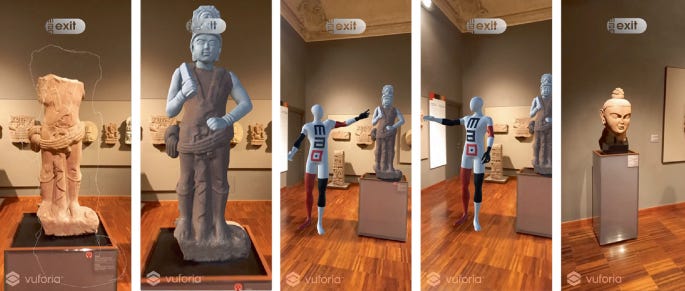
The Australian schoolkids and their Chinese counterparts shouted mock challenges to each other, waving arms, some balling their little fists, putting on their best ‘I’ll show you’ face. Marta Achacollo let it go. It would happen anyway, might as well get it over with. Some kids never grew tired of it.
After they’d exchanged their ritual challenges, each group moved to the opposite side of the room, then turned around and sprinted at each other, arms flailing, screaming at the top of their lungs. Instead of clashing violently, the virtual groups just run through each other, to everybody’s huge mirth. For a few minutes, the mock fighting continued until the kids grew tired or burst out laughing.
“You’ve had your fun,” Marta said, instantly translated, “now behave. Because naughty children will not see the dinosaurs.” Marta greatly preferred the carrot over the stick, which is why she saved the dinosaurs in the forest for last. Both Grade Nine from Shenzhen Middle School, Luohu District, Shenzhen and Group Nine from Albert Park College, Melbourne fell into an awed silence. Until one kid broke the silence with a heartfelt “Dinosaurs are so cool!” and everybody shouted in agreement.
“Now that I have your attention,” Marta said, “please keep to these simple rules. One, no walking through walls. If you walk through a wall, your FIT will be disconnected until you walk back in. You will see that it’s no fun. So, repeat after me: no walking through walls.”
“No walking through walls.” A mixture of Aussie-tinted English, perfect machine translations, and the odd Chinese overtone echoed back.
“Second, no food fights. I know the food is not really here in Madrid, but your teachers on the other side of the world will have to clean it up. So, no food fights.”
“No food fights.” Even the machine translation could not filter the disappointment of many voices. “Third, and final, no more insults. You can mock fight, walk through each other, and play all you want, but I will not tolerate disrespect or abuse. Say after me: respect.”
“Respect.”
“Very good,” Marta said, as her digital assistant signalled her that her colleague Julio’s group just left it, “let’s go to the first exhibition—the building bridges room.”
In that exposition-cum-try-out space, a virtual landscape with rivers, valleys, and rifts was projected, on a one-to-twenty scale—with a variety of roads and railways, but without any bridges connecting them.
The kids were divided in small groups, each group tasked with building a bridge on a certain location, using the virtual tools and materials at hand. Some made crazy constructions at first, laughing hard when these collapsed as a truck or train was driven over it for testing. However, they quickly became more serious when they found that this gave them very low points.
The young would-be builders not only had to test the strength, but also cost and construction time. As their understanding improved, their points went up. Some managed to get in the top ten score of their particular project, and a rare one even set a top score. By that time the joking had stopped as all were completely absorbed in their task. More than a few were disappointed when Marta told them they had to move on to the next exhibit.
Marta led the kids into the Hall of the Senses, where they performed scientific experiments that demonstrated how their five senses—sight, sound, smell, taste and feeling—worked and could be fooled. Then onwards to the next collaborative, interactive project: virtual space elevator, where international collaboration was required. And finally to the enchanted forest where the kids—in equally divided groups from both countries—were confronted with flora and fauna both real and imagined, where they went on a quest for an all-important object—an ark of the covenant, a holy grail, a ring of power—while being confronted with dangers, puzzles and hidden tokens needed to complete the quest.
In the enchanted forest, the interactive program adapted to the skills of each group, adapting the ease—or difficulty—of the tasks so that each group finished (Marta kept a wary eye on that) before their time at the MUNCYT was up. In the end, after defeating orcs, outsmarting dragons, and herding dinosaurs, while solving hard-yet-realistic puzzles the kids were exhausted, but very satisfied, as well. Quite a few Australian and Chinese kids had become friends, some cried when they had to say goodbye while pleading to keep in touch through whatever chat app was de rigueur with the youth of today.
Marta was as tired as the kids, yet also felt good. Her partners kept bringing up raising their own kids, but Marta held off, saying she was a virtual mother to half the world already. She wanted to do something else in her spare time, knowing full well that, someday, she’d give in to their request. But not this year.
As the last of the schoolkids zapped back to their home countries, Marta took a quick look at the latest news. Drone deliveries temporarily suspended across Europe after a series of fatal and near-fatal accidents. A communiqué to everybody receiving medicine via courier to double-check the medication with a human doctor (and subsequently a cry-out from MDs for patience, as they could not keep up with demand). Self-driving cars being manned again after a series of serious accidents followed by the recurrence of traffic jams all over the continent.
Then her phone buzzed, an unknown number from Nagasaki.

Support this writer:
1. Like this post!
2. Re-stack it using the ♻️ button below!
3. Share this post on Substack and other social media sites:
1. Join my mailing list:
Author’s note: I must admit that I actually wrote this story before I wrote The Replicant, the Mole & the Impostor, and only later decided to include Dewi Kamadjojo as a character in the novel.
Why not George? Because so much science fiction (and fantasy) uses UK characters and I wanted to focus more on European characters who do not appear very much in English-language SF (and fantasy).
Why not Marta? That’s harder to say. Eventually I chose a male character (Esteban Viejos) from Spain (instead of a female character). Why? No carefully planned reason, as I sometimes just follow my gut.
On top of that, since Dewi, George, and Marta had already been involved with each other, this would be a reason for VanderPol1 Excel—the reality event’s creators—not to include George nor Martas after having already selected Dewi.
Unlike David Mitchell2 and Isaac Asimov3, I don’t want to set every of my novels (let alone short stories) in the same Universe. Admittedly, the words of the ‘Replicant’ duology and the ‘Consensual Reality’ trilogy are linked—making that my largest shared Universe, yet the ‘Forever’ duology and the upcoming ‘Divine Denouements’ duology are set in utterly different world, as are almost all my short stories (and novelettes).
Many thanks for reading!
Loosely based on Endemol, the Dutch production compay of John de Mol and Joop van den Ende that produced “Big Brother” which in its turn was the first reality TV show;
Who planned it from the start;
Who decided to retro-actively combine his robot stories with his Foundation Universe;