
Blue—Red—Green, Part 1
At the University

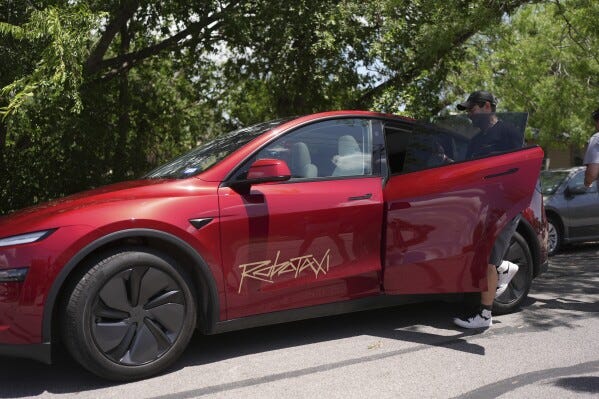
Serenity through a change of scenery. Inside a RedHail, Dewi Kamadjojo was enjoying her quiet ride through the green heart of the Dutch ‘Randstad,’ casting a thoughtful look on the blue horizon as she contemplated the notes of her upcoming lecture. Surreptitiously, she wished that the neural networks controlling the ride had made a small miscalculation, taking the self-driving car on a longer trajectory. The so-called ‘touristic route,’ to give her mind space to roam. But that, of course, was so utterly unlikely she might as well believe in miracles.
Gone were the old days—which she recalled but all too well—when the same drive would take her two hours, at least, especially in rush hour. The ubiquity of self-driving cars, hailed through apps, controlled through neural networks that were constantly updated with all the necessary data— routes of all other cars, traffic, and weather—had made those traffic jams a thing of the past. Had made rush hour a relic of the past, as well. Something anybody living in the Randstad ten years ago would have thought impossible. Yet, with everybody sharing a ride in the competing fleets of cars, the existing infrastructure was used so efficiently that traffic flowed smoothly, every hour of the day.
Good riddance to these ‘good old days’ of noxious, gas-guzzling cars driven by less competent humans (aggressive, distracted, nervous and never monitoring the road one hundred percent of the time) causing road rage, accidents, traffic jams and other harm. Welcome to today’s hyper-efficient fleets of electric, self-driving cars who caused the number of traffic accidents to plummet more than ninety percent while simultaneously increasing the usage of the roads by more than ninety.
She let out a little cough—hopefully she hadn’t caught the Manu flu, whose latest version seemed to be quite nasty. Had things still been as bad as ten years ago, she would have preferred to give her lecture through Fully Immersed Telepresence technology from her living room, but now she could take the short ride from Utrecht to the campus of TU Delft in peace, contemplating her notes on the way. She felt so relaxed her mind drifted, making some very interesting, lateral links in her field of research along the way. She could ride like this for hours if it wasn’t for ...
—the car crash at the opposite road—
A sight so rare it shocked Dewi and her quiet fellow passengers into an even deeper silence.
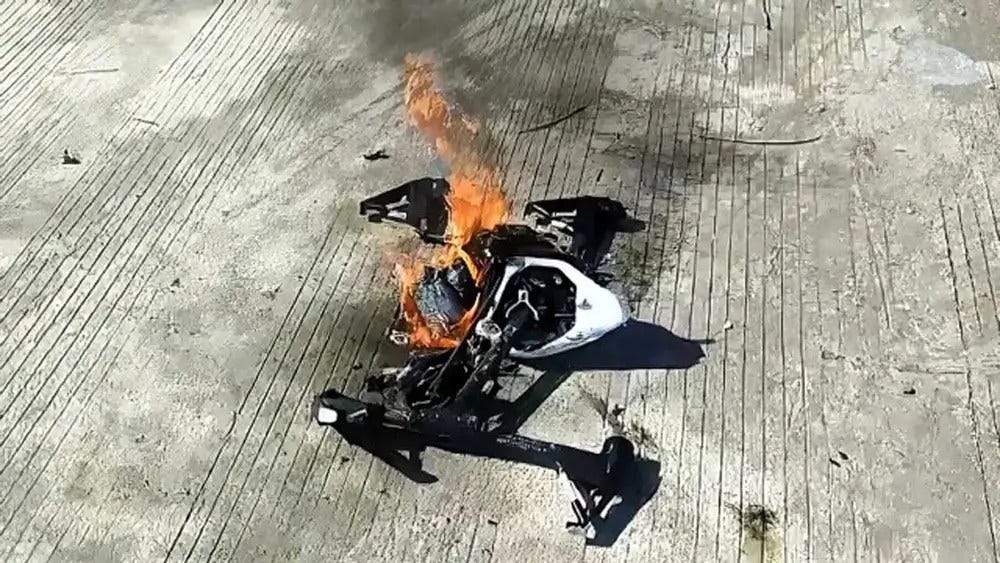
Like a Doppler effect in crescendo through a sea of green tranquillity, George Kwanju awoke from his self-hypnosis through the arrival of the red drone—in Oxford’s clear blue skies—carrying his latest batch of medicines. Sitting on his balcony, he thanked the powers of progress for these medicines, as they didn’t exist ten years ago. Now his Asperger’s syndrome—and other forms of autism—are becoming treatable, and while he barely noticed his condition at first (he figured all the others were different, and he was the norm), eventually he recognised that he was the odd one out and might need help. Even better, with all the progress of the past decade, he could get help.
Initially, many doctors were sceptical when the pharmaceutical industry started to use neural networks to measure the spread of diseases, the applied medicines, and their effects with the express goal to improve diagnoses. An approach with incredibly high stakes—one set of wrong diagnoses and many people would die. Several high-profile accidents seemed to prove the doubters right.
But Big Pharma persisted because both large savings and huge profits called. As the diagnoses improved and the growing wealth of data, with the machine learning of the neural networks eventuated better remedies, even of diseases and conditions—like George’s Asperger’s syndrome— that weren’t treatable before. Emboldened by the improved results, the pharmaceutical industry managed to convince the NHS to mandate accessibility of all health data from its users, despite the bitter protests of privacy advocates and concerned citizen groups. Their protests faded away as the NHS’ healthcare drastically improved, at a reduced cost, as promised (while Big Pharma monetised the data from all the UK’s users).
Due to his medication, George Kwanju was now fully aware of the advantages that his autism could have—the relentless focus, the deep insights—but he was also aware of the disadvantages and was constantly thinking of minimising the latter while maximising the former. In the far horizon, a lonely F-35 stealth fighter disappeared into a low-hanging cloud and George’s contented thoughts soothed his spirit until he opened the delivered meds to take his first dose and noticed in abject horror that ...
—these are the wrong prescriptions—
So wrong, in fact, that taking these would have sent him into an anaphylactic shock.

While walking through Parque de Andalucía—her green oasis in busy Madrid—Marta Achacollo was overtaken by a flock of BlueGliders, their shiny cobalt recharging skins in stark contrast to the blood red sunset. A tiny drone descended towards her, carrying a single red rose. It kept hovering in front of her until she accepted the gift. She had a fight with Javier—her boyfriend working the night shift at the local drone flight centre—but he sure did know how to make amends. Despite herself, she smiled and told her digital assistant to send a message to Javier: ‘Oh well, I forgive you.’
Marta was heading for MUNCYT—the Museo Nacional de Ciencia y Tecnología—in Alcobendas to start her night shift. In the old days, the museum was open from 10 a.m. to 8 p.m. for visitors in the flesh only, but as augmented reality was perfected, the curators realised it could be open to virtual visitors from around the world, as well. However, as the mix of virtual and actual people became too overwhelming and confusing to both visitors and guides, it was decided to open the museum to virtual visitors at night only.
It took quite some work to make the interactive activities and exhibitions suitable for virtual visitors, but it was well worth it as the museum’s attendance literally doubled overnight. As Fully Immersed Telepresence became used more intensively, the increasing number of live interactions across the globe expedited the translation abilities of the communication neural networks, leading to near-instantaneous translations. Thankfully, Marta thought, one aspect the on-the-spot translation does not even out is the cultural differences between people. She loved those as they were the icing of the interaction cake in MUNCYT’s virtual nights.
Her digital assistant buzzed and as she picked up her 3D smartphone a shining blue forget-me-not appeared in the air. Multitasking, ultra-communicative Marta immediately understood—her girlfriend Olga, the complement of her bisexual love triangle. Olga helped perfect the ‘sui generis’ technology that both gives a unique signature to a 3D GIF and prevents illegal copying of it. This enables museums like the MUNCYT to sell idiosyncratic virtual souvenirs individually, as all the attempts at copying them, so far, simply don’t have that quintessential sparkle, that quirky shine of the originals. For those who want physical artifacts, there’s always the cheap vacuum balloon shipping combined with drone delivery. ‘Yes, I’ve forgiven him,’ Marta sent to her other lover, ‘but that doesn’t mean I’m forgetting you. You just need to learn to share.’ Then a shout pierced the evening’s tranquillity, and Marta witnessed ...
—a drone falling from the sky— ... barely missing an unwitting pedestrian.
We do not at this stage know why a given drug restores cells back to health, not do we care. We simply want to harness the massive complexity of biology to help guide the answers, and then only understand why it is the answer.
– Christopher Gibson, Calculating the Incalculable
“We should stop looking at quantum phenomena as things we can’t grasp,” Dewi said as a swipe of her left hand launched a 3D animation of an electron cloud, the electrons visible-yet-invisible as they’re smeared across a lobe-shaped space according to Heisenberg’s Uncertainty Principle, “but rather as things we can goad.”
A pinching gesture causes the picture to zoom out from the atomic level into molecular realms, displaying the illustrious twisted double spiral of DNA. “As nature has done before us.”
Several quick-typed questions appeared—visible only to her—before her eyes. She dismissed all for later discussion except one. “Natasha, go ahead,” she said.
“While manipulating matter at the quantum level is cool,” Natasha said, “shouldn’t we also need to know why?”
This was not in her original lecture notes, so she had to improvise. As Natasha voiced her question, Dewi flicked through an image search at hyper speed, downloaded the most appropriate one, and started her answer.
“As we find out more through goading quantum phenomena into doing our bidding, we inevitably will get more knowledge about them.” She said as she projected Wigner’s quasi-probability distribution as a visualisation of quantum entanglement. “For instance, we know that ‘spooky action at a distance’—Einstein’s detested spukhafte fernwirkung—is real. It has been proven by the Aspect experiment,” —a quick flash of Alain Aspect’s set-up to her left— “is used in nature,” —an overview of the photosynthesis process to her right— “and has been used to send messages.” —a report on the University of Vienna’s successful experiment above her.
“Even crazier,” —an animation of a single hand moving so fast it’s clapping itself— “that, although it’s quite a wild assumption, the double slit experiment might be explained by a single particle being entangled with itself.”
The student crowd whistled, roared, and applauded—albeit with two hands—in appreciation.
“All these findings have shown us that quantum entanglement—one of the quantum phenomena we’re already using—might be a basic feature of reality, rather than an effect that we don’t fully understand.” —picture of a splitted photon— “That in itself gets us one step closer on the road to understanding.”
She wiped away some imaginary sweat from her forehead. “Nobody said it would be easy. But we should also be prepared—only after we’ve tried every approach imaginable—that some things might simply be beyond our understanding.” —the myriad of projections around her started to swirl and became one big question mark— “Like the neural networks that play an increasingly important role in our life—without them I’d probably still be stuck in traffic—” —picture of a highway jammed with traffic— “we know that they work, but not how they do it. The neural networks probably don’t even know that themselves, either.”
“Let’s call this ‘unknowability’: the impossibility to know certain complex processes. This unknowability might be a requirement for certain quantum phenomena to work, the smallest possible manifestation of Gödel’s Incompleteness Theorem, a Planck limit of knowledge?”—an animation of a galaxy, zooming in to a solar system, planet Earth, The Netherlands, Delft, the lecture room Dewi is in, her right hand, the cells of her skin, the DNA of one of these cells, the proton in one of its atoms, the gluon holding two quarks of the proton together, intense quantum fuzziness dissolving into, again, a question mark—
“Even proving that,” she concluded this sidestep from her lecture, “is still moving improving our understanding, as it clearly delineates one of its limits.”
The attendees, both real and virtual, rose to a standing ovation. Dewi gave them five seconds, then gestured for everybody to sit down. “Now back to the original subject of this lecture.”
Outwardly cool, Dewi was both quite relieved and happy that she pulled off this little tour de force. It was one of the reasons her lectures were always fully booked, with a waiting list bursting at the seams. Such extended sidesteps were somewhat accidentally-on-purpose with her, as she liked to offer her students glimpses of the hidden depths beyond the subject at hand.
Next, though, she slowed down the pace and minimized the fireworks as she really wished to teach the subject, not merely bedazzle her students. She stayed focused and on topic, only allowing for two minor sidesteps after appropriate questions, and with impeccable timing finished the lecture exactly on time. Throughout the lecture, as she watched her audience, something nabbed at her mind, as if she ought to see something, yet couldn’t quite put her finger on it, a superposed premonition, a sense of déjà vu. Since she didn’t believe in synchronicity—except, possibly, as a manifestation of quantum entanglement—she shook it off. Probably her mind chasing an apparition.
She glimpsed her newsfeed and noticed that the car crash she witnessed was not the only one today—several more had happened. ‘An extremely rare occurrence,’ according to the source. Then she noticed that an Asian man with grey sideburns sent her a DM, requesting to meet her after the lecture. Intrigued, Dewi accepted it as she didn’t recognise the man. She was horrible at remembering names, but her memory for faces was second to none, and she was certain she hadn’t seen him before.
The ‘i’-symbol on his lapel was lit, indicating his presence here was virtual. If he’s indeed from the Far East, Dewi thinks, he must be up at an ungodly hour. “A true honour and a great pleasure to be able to attend one of your, justifiably, famous lectures, Professor Kamadjojo,” he said. “Allow me to introduce my humble self: Michio Nakamura, from Nagasaki, Japan.” He bowed in greeting.
“Doctor Nakamura,” Dewi said, as recognition dawned, “the director of the Nippon Cloud Computing Institute? Sir, the honour is all mine.” Dewi returned the bow.
“Thank you. Sorry to be so direct, but we urgently need your talents in a crisis that is developing right now.”

Support this writer:
1. Like this post!
2. Re-stack it using the ♻️ button below!
3. Share this post on Substack and other social media sites:
1. Join my mailing list:
Author’s note: this novelette appeared in Qualia Nous, vol. 2, under a pseudonym. This is the second novelette that’s set in the same Universe as The Replicant, the Mole & the Impostor (and published after the serialisation was finished, as promised).
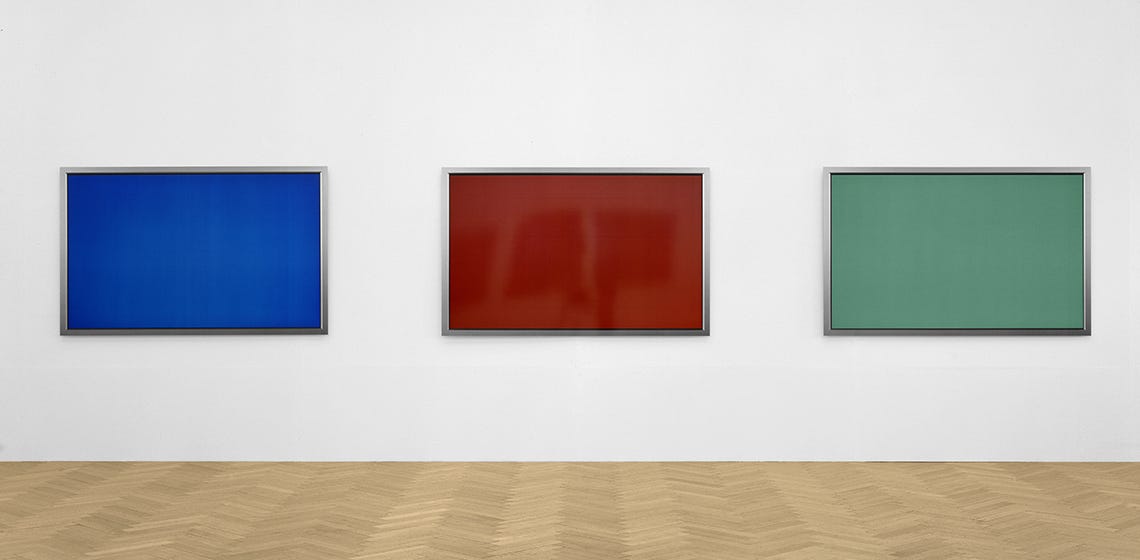
When searching for accompanying art for this story, I stumbled upon Günther Selichar’s who’s afraid of blue, red and green?, which is obviously derived from—or at the very least inspired by—Barnett Newman’s Who’s Afraid of Red, Yellow and Blue. Four versions, while I was cutting my novelette “Blue—Red—Green” in four parts, so how could I resist?
I didn’t, even if the first three series of three paintings were all exactly the same size (125 x 200 centimetres), with exactly the same frames. As far as I can trace back, they’re the same three prints produced in 2002 — 20031 that were displayed in three different galleries (Landesgalerie Linz, 2004; Cornerhouse Manchester, 2007; and Fotogalerie Wien, 2020). It’s only in the fourth part that the paintings are smaller—42.7 x 68.3 centimetres—and that the green one has a decidedly2 different3 hue4.
Sometimes I think I took the wrong vocation.
Why one would need two years to produce three plain-coloured canvasses is beyond me. Then again, I’m not an artist;
Oh well, there are reflections on all the alost all the glasss covers of the paintings. Admittedly, even anti-reflective glass doesn’t take away all of the reflections;
Not sure about the other two;
While you can clearly see the reflection of the photographer and his tripod in both the green and red painting. Aren’t professional photographers supposed to know about lighting angles and reflection? Then again, I’m not a professional photographer;